
Best Percussion Massagers for Fitness Users
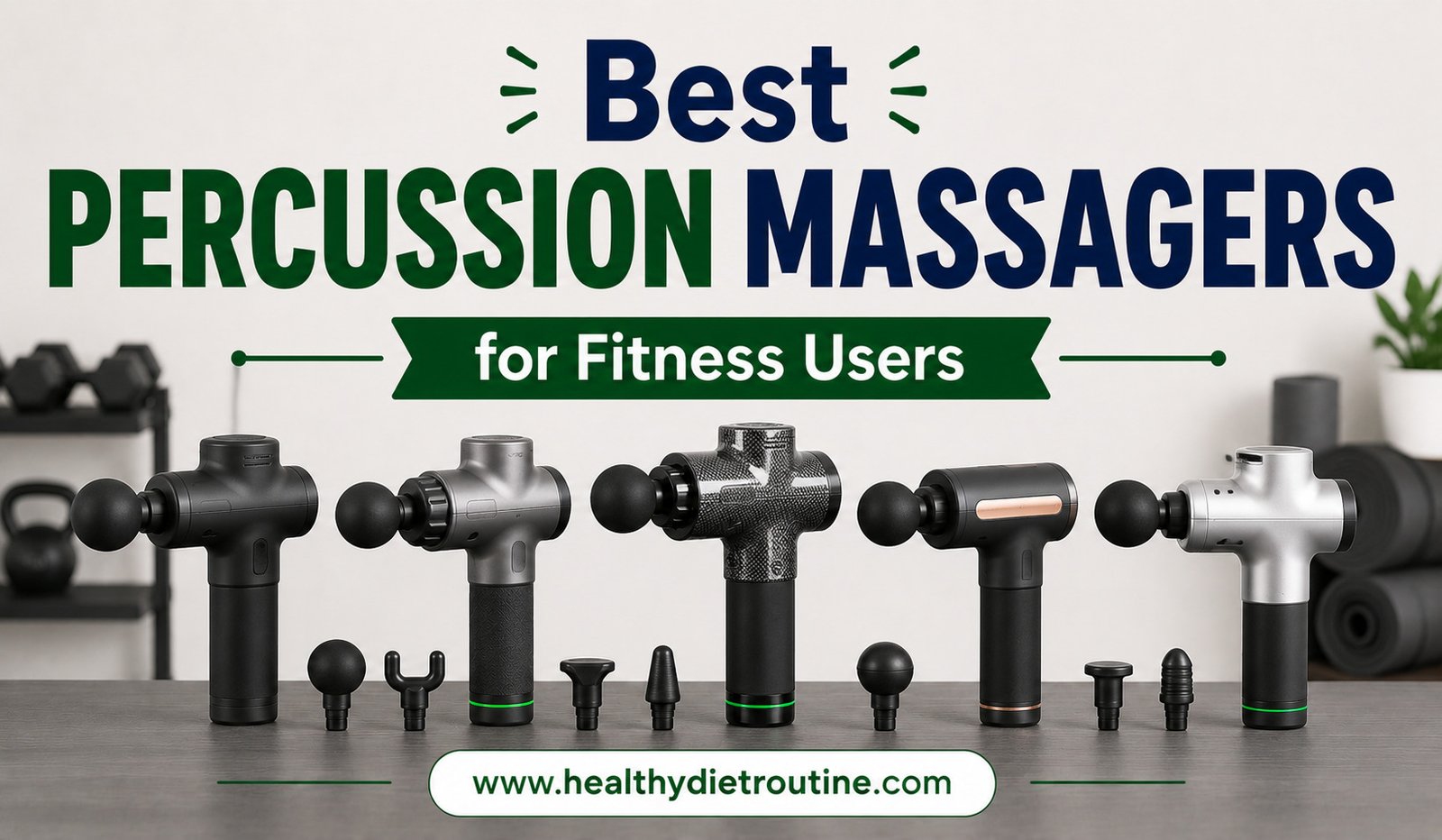
Recovery is an essential part of staying active. Whether you lift weights, run, cycle, play sports, or follow home workouts, your muscles need time to recover after physical activity. Along with sleep, hydration, nutrition, stretching, and appropriate rest, many fitness enthusiasts use percussion massagers as part of their recovery routine.
Also commonly called massage guns, percussion massagers deliver rapid pulses to soft tissues using interchangeable attachments. They are designed to provide a massage-like sensation and can be used on areas such as the thighs, calves, glutes, hamstrings, and shoulders.
Research on percussive therapy is still developing. A 2026 systematic review and meta-analysis found that percussive therapy may improve some measures of explosive-performance recovery, but it did not show clear benefits for maximum strength recovery or delayed-onset muscle soreness. The researchers also emphasized that the available evidence is still limited and that dosage findings should not be treated as universal instructions.
What Is a Percussion Massager?
A percussion massager is a handheld device that uses a motor to produce repeated, rapid movements. When an attachment is placed against a muscle, these pulses create a tapping or pressure sensation.
Most models come with several interchangeable heads. Different attachments may be designed for broad muscle groups, smaller areas, or more concentrated pressure.
Unlike traditional massage tools, percussion massagers are powered by a battery or electrical source. This allows users to apply consistent vibrations without manually creating the movement.
For fitness users, their biggest appeal is convenience. A massage gun can be kept at home and used before or after exercise without requiring a professional appointment.
Why Fitness Users Use Percussion Massagers
The popularity of massage guns has grown among athletes and recreational exercisers because they are portable and easy to operate. Some research suggests that percussion therapy can temporarily improve flexibility and range of motion. A systematic review also reported potential recovery-related benefits, although the evidence base was limited and several studies had methodological concerns.
A percussion massager may therefore be useful when you want to prepare your muscles for movement or create a relaxing sensation after training.
It is important, however, not to view a massage gun as a replacement for proper recovery. Using one does not compensate for inadequate sleep, poor nutrition, excessive training, or insufficient rest.
Types of Percussion Massagers to Consider
1. Compact Percussion Massagers
Compact models are lightweight and easy to carry. They can be useful for people who travel to the gym, participate in outdoor sports, or want a recovery tool that takes up little storage space.
The trade-off is that smaller devices may have less power or shorter battery life than larger models.
2. Full-Size Massage Guns
Full-size percussion massagers generally provide a more substantial grip and may offer stronger motors and longer battery life.
They can be suitable for regular gym users who want to work on larger muscle groups such as the quadriceps, hamstrings, and glutes.
3. Mini Massage Guns
Mini models are designed primarily for portability. They are often easier to carry in a gym bag or backpack.
They may be particularly useful for fitness enthusiasts who travel frequently and want something compact for occasional muscle relaxation.
4. Multi-Speed Percussion Massagers
Devices with several speed levels provide greater flexibility. A lower setting may be appropriate for a gentle session, while higher settings can provide a stronger sensation.
Having multiple settings is generally more useful than simply choosing the device with the highest maximum speed.
Features to Look for in the Best Percussion Massager
The best percussion massager for one person may not be the best choice for another. Focus on practical features that match your training routine.
Adjustable speed: Multiple speed settings let you control the intensity according to the muscle group and your comfort.
Interchangeable attachments: Different heads can make the device more versatile for large and smaller muscle groups.
Battery life: A longer-lasting battery is convenient if you exercise frequently or travel with the device.
Ergonomic grip: A comfortable handle makes it easier to control pressure and reach different areas.
Weight: A heavy massage gun can become tiring during longer sessions, particularly when treating areas that require holding the device at an awkward angle.
Noise level: A quieter motor can make the device more pleasant to use at home or in a shared gym environment.
Portability: A compact design and carrying case can be useful for athletes who travel.
Simple controls: Easy-to-understand buttons or a display make it easier to adjust speed without interrupting your routine.
How to Use a Percussion Massager
Before using a massage gun, identify the muscle group you want to target and choose a comfortable speed. Place the attachment gently against the muscle instead of immediately applying heavy pressure.
Move the device slowly across the muscle rather than keeping it aggressively pressed against one spot for an extended period.
For a pre-workout routine, a short and gentle application may be more appropriate than a long, intense session. The purpose is to prepare for movement rather than exhaust the muscle.
After exercise, some people use a percussion massager as part of their cooldown and recovery routine. However, research does not consistently show that massage guns reduce delayed-onset muscle soreness or improve every measure of physical recovery.
A 2023 controlled study involving active adults found that five minutes of massage-gun treatment after strenuous calf exercise did not significantly improve the measured physical or perceptual recovery outcomes.
Can Percussion Massagers Improve Workout Recovery?
The answer is more complicated than many product claims suggest.
A 2026 systematic review of 12 randomized controlled trials found that percussive therapy improved countermovement-jump recovery compared with control, but the certainty of that evidence was low. It did not clearly improve maximum voluntary contraction recovery or delayed-onset muscle soreness.
Earlier reviews have found that massage guns may provide short-term improvements in flexibility, range of motion, and some recovery-related outcomes. However, the research has been limited by small studies, different treatment protocols, and inconsistent methods.
This means a massage gun can be a useful recovery accessory, but it should not be considered a guaranteed way to eliminate soreness or dramatically improve athletic performance.
Using a Percussion Massager Before Exercise
Some fitness users prefer using a massage gun before training. Research suggests that percussive therapy may temporarily improve range of motion and flexibility without necessarily causing the performance reductions sometimes associated with prolonged static stretching.
If you use one before exercise, keep the session controlled. The goal should be to feel ready to move, not to create significant muscle fatigue or discomfort.
A short session followed by dynamic movement and a sport-specific warm-up can be a more sensible approach than relying entirely on the massage gun.
Safety Tips for Massage Gun Users
A percussion massager should be used on soft muscle tissue rather than directly over bones or joints. Avoid aggressive use on the front of the neck, spine, or other sensitive areas.
Do not use the device over open wounds, irritated skin, recent injuries, or areas where you have unexplained pain.
More pressure is not necessarily more effective. Excessive intensity can leave muscles feeling more irritated, particularly when the device is used immediately after demanding exercise. One controlled study even observed a small increase in perceived calf soreness after immediate post-exercise massage-gun use.
People with certain medical conditions, significant injuries, recent surgery, or other health concerns should ask an appropriate healthcare professional whether percussion therapy is suitable for them.
If pain is severe, persistent, or associated with swelling, weakness, numbness, or restricted movement, professional assessment is more appropriate than repeatedly using a massage gun.
Percussion Massager vs Foam Roller
Both tools can be useful, but they offer different experiences.
A foam roller uses your body weight to create pressure over a larger area. It is inexpensive, requires no electricity, and can be useful for broad mobility and recovery exercises.
A percussion massager provides targeted mechanical pulses and allows you to control the pressure more precisely. It is generally easier to use on specific areas without positioning your entire body over a roller.
For fitness users, having both can provide flexibility. A foam roller can work well for larger muscle groups, while a percussion massager can be useful when you want targeted treatment.
Who Can Benefit From a Percussion Massager?
A percussion massager may be worth considering for:
- Regular gym users
- Runners and cyclists
- Recreational athletes
- Strength-training enthusiasts
- People following home workout programs
- Sports players looking for a portable recovery tool
- Fitness users who prefer self-massage
You do not need to be a professional athlete to use a massage gun. However, the device should be considered a convenience and recovery accessory rather than essential fitness equipment.
How to Choose the Best Percussion Massager for Fitness
Start by considering your exercise routine. If you train several times a week and work on multiple muscle groups, a full-size model with multiple attachments and speed settings may be useful.
If you travel regularly, a mini or compact model may be more practical. Beginners may benefit from a device with simple controls and moderate intensity settings rather than an extremely powerful model.
Comfort also matters. A device that is too heavy, noisy, or difficult to hold may end up sitting unused. Battery life, grip design, attachment quality, and ease of cleaning can be just as important as motor power.
Most importantly, avoid choosing a massage gun based entirely on marketing claims about deep tissue recovery or instant soreness removal. Current research supports some short-term effects, but the overall evidence remains mixed.
Final Thoughts
The best percussion massagers for fitness users are practical, comfortable, adjustable, and suited to the way you train. A good model can provide a convenient way to incorporate percussive therapy into a warm-up or recovery routine.
Research suggests potential benefits for short-term range of motion, flexibility, and certain recovery measures, but evidence for reducing muscle soreness or improving maximum strength recovery is not conclusive.
For most fitness users, the best approach is to treat a percussion massager as one part of recovery rather than a complete solution. Combine sensible use of the device with adequate sleep, hydration, balanced nutrition, rest days, mobility work, and a well-structured training program.
When used at a comfortable intensity and on appropriate muscle areas, a percussion massager can be a convenient addition to a home fitness setup and make regular recovery routines easier to maintain.