
Digital Workout Logs vs Traditional Fitness Journals
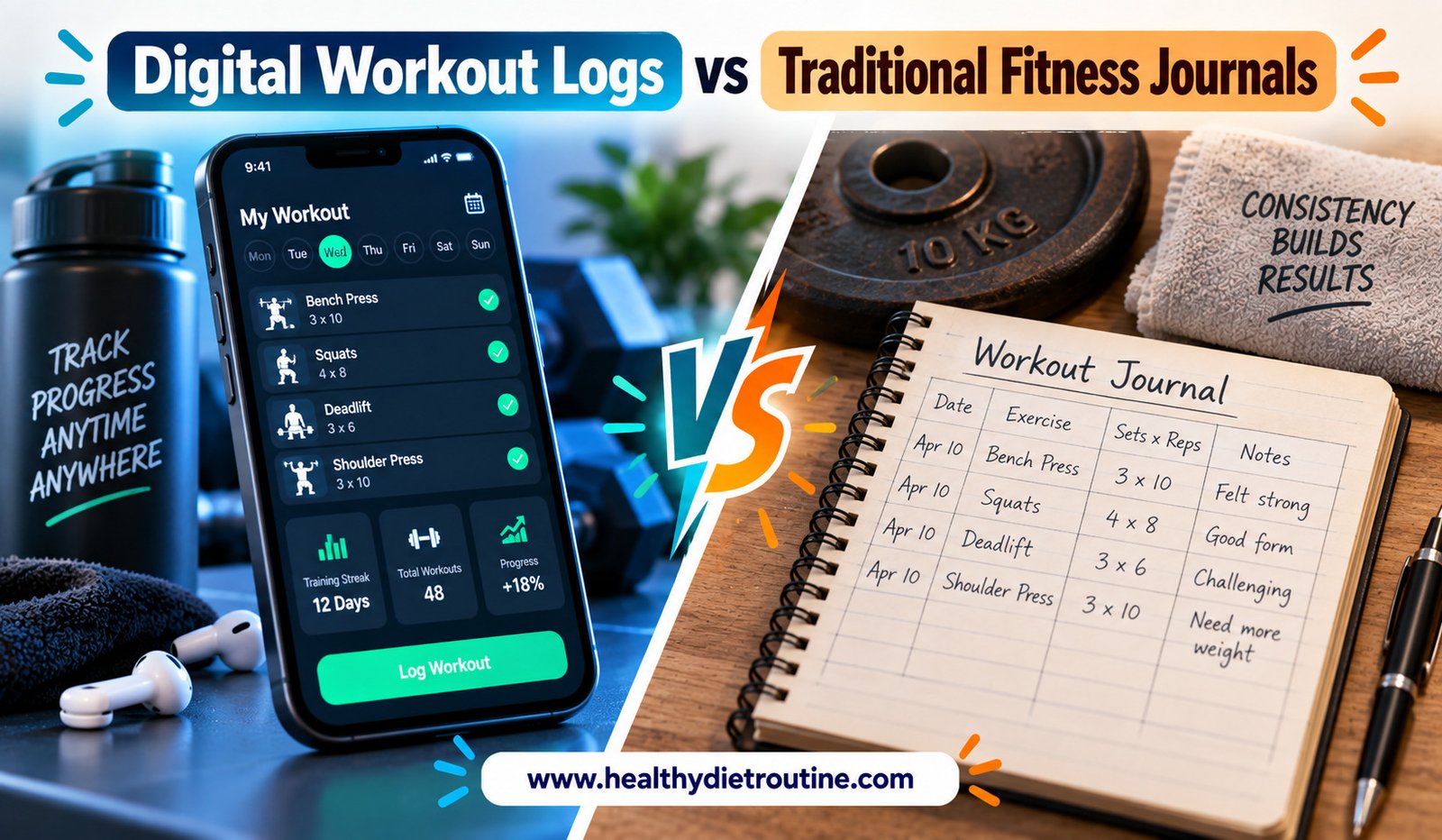
Tracking workouts has been part of fitness routines for decades. Before smartphones and fitness applications became common, people recorded exercises, weights, repetitions, running distances, and personal goals in notebooks or dedicated fitness journals.
Today, digital workout logs have changed the way people record their training. Smartphone apps and online platforms can automatically organize workout information, calculate progress, create charts, and make previous sessions available within seconds.
Both digital workout logs and traditional fitness journals can be effective. The better option depends on how someone trains, what information they want to record, and how much convenience they expect from their tracking method.
Understanding the differences can help fitness enthusiasts choose a system they are more likely to use consistently.
What Is a Traditional Fitness Journal?
A traditional fitness journal is usually a notebook, diary, or printed workout planner used to record exercise information manually.
A person might write down the date, exercises performed, number of sets, repetitions, weights, workout duration, and personal observations.
For example, someone performing a strength workout might record that they completed three sets of squats with a particular weight. They could also write notes about how difficult the workout felt or whether they experienced any challenges.
The biggest advantage of a paper journal is simplicity. There are no apps to install, accounts to create, or batteries to charge.
You simply open the notebook and write.
What Is a Digital Workout Log?
A digital workout log stores exercise information electronically through a smartphone app, tablet, computer, or web-based platform.
Depending on the application, users may record exercises, weights, repetitions, sets, distance, pace, workout duration, rest periods, and other information.
Digital systems can also organize this information automatically. Instead of searching through several pages of a notebook, users can select an exercise and immediately view previous sessions.
Some platforms provide additional features such as progress charts, workout reminders, exercise libraries, statistics, and training plans.
This makes digital logs more than simple electronic notebooks.
Digital Workout Logs vs Traditional Fitness Journals
The biggest difference between the two methods is how information is recorded, stored, and used.
Traditional journals rely almost entirely on the user. Digital workout logs can automate some of the organization and analysis.
Neither method is automatically better. Each has advantages that may appeal to different types of fitness users.
Convenience and Accessibility
Digital workout logs are highly convenient for people who already carry a smartphone during exercise.
Instead of carrying a separate notebook and pen, everything can be recorded on the same device.
Digital records are also easy to access. A user can review previous workouts while at the gym, at home, or while planning their next training session.
Traditional journals require physical access to the notebook. If you leave it at home, reviewing your previous workout may not be possible.
For people who move between different gyms or exercise locations, digital access can be especially convenient.
Speed of Recording
Writing information by hand can be quick, particularly for people who are accustomed to keeping a fitness journal.
However, digital apps can reduce certain repetitive tasks.
For example, an app may remember commonly performed exercises, allowing users to enter their latest weights and repetitions without rewriting the entire exercise name.
Some apps can also automatically calculate workout volume or organize sessions by date.
This can make digital tracking more efficient for people who perform structured workouts frequently.
Organization of Workout History
Traditional fitness journals can become difficult to navigate after months or years of use.
A notebook may contain hundreds of pages, making it challenging to find a particular exercise or compare workouts from different dates.
Digital workout logs can organize this information automatically.
Users may be able to search for a specific exercise, filter workouts by date, or review historical performance from a single screen.
This becomes increasingly valuable as the amount of training data grows.
Tracking Progress Over Time
One of the strongest advantages of digital workout logs is the ability to analyze progress.
A digital application may display changes in weight, repetitions, workout frequency, or other measurements through charts and statistics.
For example, a user could view how their performance in a particular exercise changed over six months.
Traditional journals can also provide this information, but the user generally has to compare entries manually.
This can take more time and make long-term trends harder to identify.
Personal Notes and Workout Feelings
Traditional fitness journals have an advantage when it comes to free-form writing.
A notebook gives users unlimited flexibility to write about how they felt during a workout, what they ate, how well they slept, or what they want to change next time.
Digital apps can provide note sections, but the experience may feel less natural for people who enjoy writing longer reflections.
For athletes who want to maintain a detailed fitness diary rather than simply record numbers, a paper journal can still be appealing.
Accuracy and Data Entry
Both methods depend on the user entering accurate information.
Writing a workout in a notebook does not automatically make the information more reliable. Similarly, a digital app can contain incorrect data if the user enters the wrong weight or number of repetitions.
Digital systems can reduce some calculation errors because they may automatically calculate totals and statistics.
For example, an app may calculate total training volume from weight and repetitions.
However, the original data still needs to be entered correctly.
Motivation and Visual Feedback
Digital workout logs can make progress more visible.
Charts, statistics, achievement notifications, and personal-record tracking can provide immediate feedback after a workout.
Seeing a graph gradually move upward may encourage users to continue training.
Traditional journals can also be motivating, particularly for people who enjoy physically seeing their handwritten progress accumulate.
There is something satisfying about looking back through an old notebook and seeing months of completed workouts.
The motivational advantage therefore depends largely on personal preference.
Privacy and Data Storage
Digital tracking introduces a consideration that traditional journals largely avoid: data privacy.
Workout applications may store information on a device or in cloud-based systems. Depending on the platform, this information could include workout history, body measurements, goals, and other personal fitness information.
Users should understand how an application handles their information and review its privacy settings.
A paper journal does not depend on an online account or cloud service. However, it can be lost, damaged, or destroyed.
Both systems have different advantages and risks when it comes to keeping long-term records.
Reliability Without Technology
A traditional fitness journal does not need electricity, an internet connection, or a smartphone.
This can be useful when exercising outdoors, traveling, or training in situations where electronic devices are inconvenient.
Digital logs, on the other hand, depend on the device and software being available.
Battery life, application problems, device upgrades, or account access can occasionally create obstacles.
For some users, the simplicity of paper remains one of its biggest advantages.
Digital Logs Can Support Progressive Training
Structured strength training often involves gradually increasing workload over time.
A digital log can make this process easier by showing exactly what was completed during previous sessions.
For example, if a user wants to increase the weight of an exercise, they can quickly check the previous workout instead of relying on memory.
This can help create a more organized progression strategy.
However, users should not increase training loads simply because an app suggests progression. Exercise technique, recovery, experience, and individual ability should always be considered.
Which Option Is Better for Beginners?
Beginners may benefit from either approach.
A traditional journal can teach someone the basic habit of recording workouts without introducing complicated technology.
A digital app can be useful for beginners who prefer smartphones and want guidance, exercise demonstrations, reminders, or automatic progress summaries.
The most important factor is consistency.
A simple notebook that someone uses regularly can be more useful than an advanced application that they stop using after a few weeks.
Which Option Is Better for Experienced Fitness Users?
Experienced users often have more detailed training histories, which can make digital organization particularly valuable.
Someone who has trained for several years may want to compare performance across hundreds of workouts. Searching through physical notebooks can become increasingly time-consuming.
Digital systems can make large amounts of historical information easier to search and analyze.
However, experienced athletes who prefer detailed written reflections may still choose paper journals.
Can You Use Both?
There is no rule saying you must choose only one.
Some people use a digital workout app for numbers and a traditional notebook for personal observations.
For example, an app can record sets, repetitions, weights, and workout duration, while a paper journal can be used for reflections about energy levels, motivation, technique, or training goals.
Combining both approaches can provide the organizational benefits of digital tracking with the personal experience of traditional journaling.
How to Choose the Right Workout Log
Think about what you actually want from your tracking system.
If you want automatic calculations, searchable workout history, charts, reminders, and easy access across devices, a digital workout log may be the better option.
If you prefer simplicity, handwriting, flexibility, and complete independence from technology, a traditional fitness journal may suit you better.
Cost can also be a consideration. A basic notebook is inexpensive, while some workout applications may include subscription-based features.
Ultimately, convenience should not come at the expense of consistency.
Final Thoughts
Digital workout logs and traditional fitness journals both provide an effective way to track training progress.
Digital systems stand out for organization, accessibility, automated calculations, searchable histories, and visual progress reports. Traditional journals offer simplicity, flexibility, privacy from online platforms, and a more personal way to document fitness experiences.
The right choice depends on the individual.
Someone who enjoys technology and wants detailed statistics may prefer a digital workout log, while someone who likes handwriting and simplicity may find a traditional journal more satisfying.
What matters most is creating a reliable record of your training and actually using it. Whether the information is stored in an app or written in a notebook, tracking workouts can help turn exercise from an occasional activity into a more structured and measurable long-term habit.