
Easy Balance Exercises to Add to Your Routine
Balance is an important part of everyday movement, but it is often overlooked when people think about fitness. Good balance helps you walk, climb stairs, change direction, stand on uneven surfaces, and perform many daily activities with greater control.
The good news is that balance exercises do not require a gym, complicated equipment, or advanced athletic ability. Many simple movements can be performed at home using your body weight and a sturdy surface for support.
If you are a beginner, start with exercises that feel stable and comfortable. As your confidence improves, you can gradually reduce support or make the movements more challenging.
Here are some easy balance exercises to add to your routine.
Why Balance Training Matters
Balance involves coordination between your muscles, joints, eyes, inner ear, and nervous system. Practicing balance can help you become more aware of your body’s position and control your movements more effectively.
Balance is particularly useful during everyday activities. Standing on one leg while putting on clothing, stepping over an object, walking on different surfaces, or turning quickly all require some degree of balance.
You do not need to spend a long time training balance. Even a few minutes incorporated into a regular workout can provide useful practice.
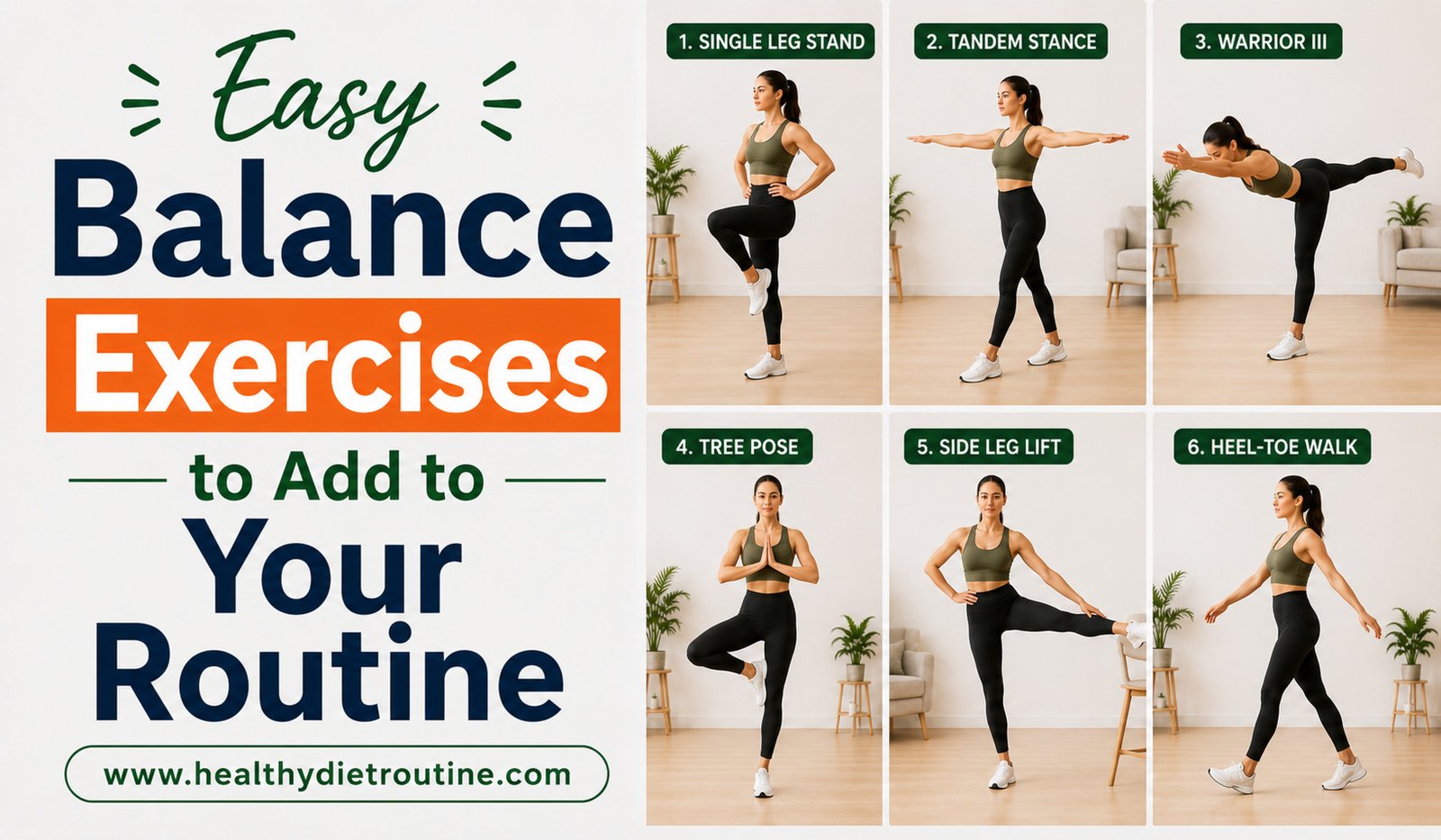
1. Single-Leg Stand
The single-leg stand is one of the simplest ways to begin balance training.
Stand upright near a sturdy chair, countertop, or wall. Hold the support lightly if needed and slowly lift one foot from the floor.
Try to maintain the position for 10–20 seconds, then switch legs.
As you become more comfortable, reduce how much you rely on the support. Keep the surface nearby so you can steady yourself if necessary.
2. Heel-to-Toe Walk
Heel-to-toe walking challenges your ability to maintain balance while moving.
Stand upright and slowly place the heel of one foot directly in front of the toes of the other foot. Continue walking forward in a straight line.
Take small, controlled steps.
Perform the exercise near a wall or in an open area where there are no obstacles. Beginners can start with a few steps and gradually increase the distance.
3. Sit-to-Stand
Sit-to-stand exercises combine balance, leg strength, and coordination.
Use a sturdy chair. Sit comfortably with your feet on the floor. Lean forward slightly and stand up in a controlled manner. Then slowly lower yourself back into the chair.
Try 8–12 repetitions.
Avoid using a chair with wheels or one that can slide easily.
4. Standing Knee Raises
Standing knee raises can challenge balance while strengthening the muscles involved in everyday movement.
Stand near a sturdy surface and lift one knee toward your waist or as high as feels comfortable. Lower it slowly and repeat with the other leg.
Perform 8–10 repetitions per side.
If necessary, keep one hand on a wall or chair until you feel more stable.
5. Side Leg Raises
Side leg raises work the muscles around the hips while requiring you to stabilize yourself on one leg.
Stand beside a sturdy support. Slowly move one leg out to the side and then return it to the starting position.
Try 8–12 repetitions per side.
Keep your upper body relatively still and avoid swinging your leg.
6. Backward Leg Extensions
Backward leg extensions are another simple supported balance exercise.
Stand upright while holding a stable surface. Slowly extend one leg backward without leaning forward excessively.
Return the leg to its starting position and repeat.
Complete 8–12 repetitions per side.
Keep the movement small and controlled.
7. Marching in Place
Marching in place may look simple, but it involves repeatedly shifting your weight from one foot to the other.
Stand upright and alternate lifting your knees. Keep your movements controlled and maintain a comfortable pace.
March for 30–60 seconds.
If you find it difficult, lower your knees and hold a stable surface for additional support.
8. Toe-to-Heel Rocking
This exercise helps you practice shifting your weight forward and backward.
Stand with your feet comfortably apart and hold a sturdy surface if necessary. Slowly shift your weight toward your toes and lift your heels slightly. Then shift your weight backward and lift your toes slightly.
Repeat 8–12 times.
Keep the movement small and controlled.
9. Side-to-Side Weight Shifts
Weight shifting is a useful starting point for beginners who are not yet comfortable standing on one leg.
Stand with your feet apart. Slowly shift your weight onto your right leg, then move back through the center and shift toward your left leg.
Continue for 30–60 seconds.
As you become more confident, you can gradually make the movement more dynamic.
10. Step-Ups
If you have access to a stable, low step, step-ups can challenge balance and leg strength.
Place one foot onto the step and bring the other foot up. Step back down carefully and repeat on the other side.
Start with a low platform and use a handrail or stable support when appropriate.
Try 6–10 repetitions per side.
Never use an unstable chair, stool, or makeshift platform for step exercises.
11. Tandem Stand
A tandem stand places one foot directly in front of the other, similar to standing along a narrow line.
Stand near a sturdy surface and place one foot directly in front of the other. Keep your body upright and hold the position for 10–20 seconds.
Switch the position of your feet and repeat.
If this is difficult, widen the gap between your feet slightly.
12. Supported Single-Leg Reach
Once you are comfortable standing on one leg, you can add a small reaching movement.
Stand beside a stable support and lift one foot slightly. With the other hand, reach gently forward or to the side.
Return to the starting position and place your foot down.
Start with a few repetitions per side and keep the range small.
The goal is to challenge your balance without losing control.
A Simple Beginner Balance Routine
You do not need to perform every exercise at once. A short routine could include:
- Weight shifts – 30–60 seconds
- Standing knee raises – 8–10 per side
- Side leg raises – 8–12 per side
- Heel-to-toe walking – 5–10 steps
- Sit-to-stands – 8–12 repetitions
- Single-leg stands – 10–20 seconds per side
Start with one round and take breaks whenever necessary.
As you improve, you can gradually increase the duration, repetitions, or difficulty.
How to Improve Your Balance Safely
Balance improves through regular practice, but safety should always come first.
Keep a sturdy chair, countertop, or wall nearby when performing standing exercises. Remove loose rugs, clutter, and other obstacles from the area where you exercise.
Start with both feet on the floor and progress gradually toward narrower stances or single-leg movements.
You should not close your eyes during balance exercises unless you are working under appropriate professional supervision. Removing visual information can make balance significantly more difficult.
Common Balance Exercise Mistakes
One common mistake is progressing too quickly. If you cannot maintain a stable position with support, removing the support may make the exercise unnecessarily risky.
Another mistake is focusing only on duration. Holding a position for a long time is not useful if your posture becomes uncontrolled.
Instead, prioritize quality. A short, controlled single-leg stand is more valuable than a longer attempt where you repeatedly lose your balance.
It is also important to avoid performing balance exercises in distracting or crowded spaces.
How Often Should You Practice Balance?
Balance exercises can be included several times per week as part of a broader fitness routine. Short sessions are often enough for beginners.
You can combine balance work with leg strengthening, flexibility exercises, walking, or other physical activities.
For example, spend five to ten minutes practicing balance after a warm-up or add a few exercises to the end of a home workout.
Consistency is more important than completing a long session once in a while.
Who Can Benefit From Balance Exercises?
Balance training can be useful for people at many fitness levels. Beginners may use it to develop coordination and body awareness, while active individuals can use more challenging variations to improve movement control.
Older adults may also benefit from balance-focused activities, although anyone with significant balance problems or a history of falls should consider working with an appropriate healthcare or physical therapy professional for individualized guidance.
If you feel unusually unsteady, dizzy, or unsafe during these exercises, stop and seek appropriate advice.
Final Thoughts
Easy balance exercises can be a valuable addition to a home fitness routine. Simple movements such as single-leg stands, heel-to-toe walking, weight shifts, knee raises, side leg raises, sit-to-stands, and supported reaches require little or no equipment.
The most important principle is to progress gradually. Start with support, practice controlled movements, and increase the challenge only when you feel confident.
A few minutes of balance training several times a week can complement strength, flexibility, and cardiovascular exercise, helping you build a more complete and functional fitness routine.