
How to Start Using Resistance Bands at Home
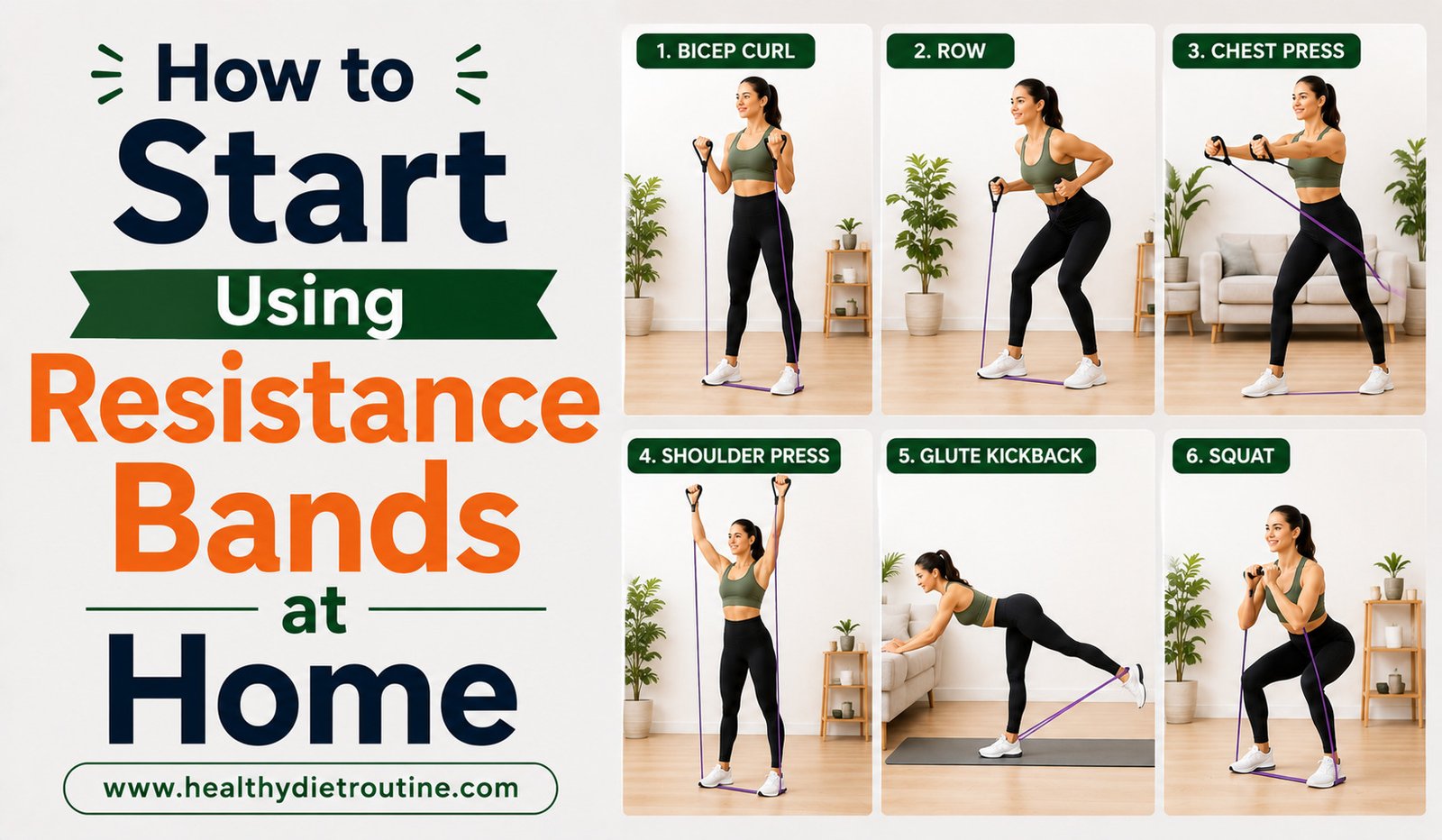
Resistance bands are a simple and versatile tool for home workouts. They are lightweight, easy to store, and can be used for many exercises that target the legs, arms, shoulders, back, and core. For beginners, they can also provide a practical introduction to resistance training without requiring a full set of gym equipment.
If you are wondering how to start using resistance bands at home, the most important thing is to learn how the bands work, choose an appropriate level of resistance, and focus on controlled movement.
You do not need a complicated routine to get started. A few basic exercises performed consistently can help you become familiar with resistance training and build a foundation for future workouts.
What Are Resistance Bands?
Resistance bands are flexible bands that provide tension as you stretch them. Unlike traditional weights, the resistance generally increases as the band is stretched farther.
They come in different shapes, sizes, and resistance levels. Some are small loop bands, while others are longer bands with handles or attachments.
Different bands can be useful for different exercises, but beginners do not need every type immediately. Starting with one or two suitable bands can be enough to learn the basics.
Why Use Resistance Bands at Home?
One of the biggest advantages of resistance bands is convenience. They take up very little storage space and can be used in small rooms.
They can also make familiar bodyweight exercises more challenging. For example, a resistance band can be placed around the thighs during certain lower-body exercises or used to create resistance during rows and presses.
Bands are also useful for people who want to vary their workouts without investing in large pieces of equipment.
However, resistance bands are not automatically safer or more effective than other forms of resistance training. Proper technique and appropriate resistance are still important.
1. Start With the Right Resistance
Beginners often make the mistake of choosing a band that is too difficult.
Start with a lighter resistance that allows you to perform an exercise with controlled technique. You should feel that your muscles are working, but you should still be able to complete the movement without jerking or losing your posture.
A useful starting point is around 8–15 controlled repetitions, depending on the exercise.
If you cannot maintain proper form, use a lighter band or choose an easier variation.
2. Learn How to Hold the Band
If you are using a long resistance band, hold it securely in your hands without wrapping it tightly around your fingers.
Make sure the band is positioned comfortably and does not create unnecessary pressure on your skin.
For exercises involving your feet, check that the band is positioned securely before beginning the movement.
Always inspect your band for cracks, tears, thinning, or other visible damage before use.
3. Practice a Resistance Band Squat
A banded squat is a simple way to introduce resistance into a familiar lower-body movement.
Depending on the band type, you can place a loop band around your thighs or hold a long band in a suitable position.
Perform a regular squat while maintaining control.
Start with 8–12 repetitions and focus on keeping your knees and feet in a comfortable alignment.
If the band makes your movement difficult, reduce the resistance.
4. Try Banded Glute Bridges
Glute bridges can become more challenging when a loop band is placed around the thighs.
Lie on your back with your knees bent and feet on the floor. Position the band securely above your knees. Lift your hips while gently pressing your knees outward against the band’s resistance.
Lower your hips slowly.
Try 10–15 repetitions.
Avoid pushing your knees excessively outward. The movement should remain controlled and comfortable.
5. Resistance Band Rows
Rows can help strengthen the muscles of the upper back and arms.
Secure a long resistance band around a suitable, stable anchor point. Hold the handles or ends of the band and stand or sit at an appropriate distance.
Pull your hands toward your body while keeping your shoulders controlled. Slowly return to the starting position.
Perform 8–15 repetitions.
The anchor point must be strong enough to handle the resistance. Never attach a band to an unstable object.
6. Banded Chest Press
A resistance band can also be used for a pressing movement.
Secure the band behind you at an appropriate and stable anchor point. Hold the ends or handles near your chest and press your hands forward.
Return slowly to the starting position.
Start with 8–12 repetitions.
If the band or anchor point does not feel secure, do not perform the exercise.
7. Banded Shoulder Press
Stand on the center of a suitable long resistance band and hold the ends near your shoulders.
Press your hands upward while keeping your torso stable. Lower your hands slowly.
Try 8–12 repetitions with light resistance.
Avoid arching your back to compensate for a band that is too difficult.
8. Banded Biceps Curls
Biceps curls are another beginner-friendly resistance band exercise.
Stand on the middle of a long band and hold the ends with your palms facing forward. Bend your elbows to bring your hands upward, then slowly lower them.
Keep your elbows relatively close to your body.
Complete 8–15 repetitions.
Avoid swinging your arms or using momentum.
9. Triceps Extensions
Resistance bands can also be used to train the back of the upper arms.
Depending on your band and setup, you can perform an overhead triceps extension or a banded press-down using a secure anchor.
Move your forearms while keeping your upper arms relatively stable.
Start with light resistance and 8–12 repetitions.
If your shoulders or elbows feel uncomfortable, stop and adjust the setup.
10. Lateral Band Walks
Loop bands can be useful for lower-body movements such as lateral walks.
Place a loop band around your thighs or lower legs, depending on your experience and the band instructions. Bend your knees slightly and take small steps sideways while maintaining tension.
Take 6–10 steps in each direction.
Keep your movements controlled and avoid allowing the band to snap your legs inward.
11. Banded Pull-Aparts
Band pull-aparts are a simple movement that can involve the muscles around the upper back and shoulders.
Hold a long resistance band with both hands in front of you. Keep your arms comfortably extended and slowly pull the band apart by moving your hands outward.
Return to the starting position with control.
Try 8–15 repetitions.
Use light resistance, especially when learning the movement.
12. Resistance Band Leg Extensions
A resistance band can add challenge to certain lower-body movements, but beginners should start carefully.
Secure the band appropriately and extend one leg against the resistance before slowly returning to the starting position.
Use only a setup recommended for your particular band and avoid creating excessive tension around the joints.
If you are unsure about the setup, choose simpler exercises such as banded squats, glute bridges, or lateral walks.
Create a Simple Beginner Band Workout
You do not need to use every exercise in one session. A simple full-body routine could include:
- Banded squats – 8–12 repetitions
- Banded glute bridges – 10–15 repetitions
- Resistance band rows – 8–12 repetitions
- Biceps curls – 8–15 repetitions
- Shoulder presses – 8–12 repetitions
- Lateral band walks – 6–10 steps per direction
Start with one round and rest between exercises. As you become more comfortable, you can gradually add another round.
How to Progress With Resistance Bands
Progression is an important part of resistance training.
When you can perform your target repetitions comfortably while maintaining good form, you can increase the challenge by using a stronger band, increasing repetitions, adding another set, or slowing down certain portions of the movement.
Do not increase everything at once.
For example, if you can comfortably perform 10 squats with a light band, you might gradually move to 12 repetitions before switching to a slightly stronger band.
Common Resistance Band Mistakes
One common mistake is using excessive resistance. A stronger band is not automatically better. If you cannot control the movement, the resistance is probably too high for that exercise.
Another mistake is allowing the band to snap back quickly. Return to the starting position slowly rather than letting the band pull your limbs suddenly.
Poor anchoring is another important concern. Never attach a band to furniture, doors, or other objects unless the setup is specifically designed and secure enough for resistance-band use.
Resistance Band Safety Tips
Always inspect your bands before exercising. Do not use a band that has visible damage, cracks, or signs of significant wear.
Make sure the band is positioned correctly and that any anchor point is secure. Keep your face and body away from the direct path of a band that could potentially snap or release.
Maintain controlled movement and avoid excessive stretching.
If you have an injury, health condition, or specific exercise restriction, consider getting guidance from a qualified healthcare or fitness professional before starting resistance training.
How Often Should You Use Resistance Bands?
Your ideal schedule depends on your fitness level and overall exercise routine. Beginners can start with a few resistance-training sessions per week and allow adequate recovery between challenging workouts.
You can combine resistance band workouts with walking, cycling, mobility exercises, stretching, or other forms of physical activity.
Recovery is part of training. Give your muscles time to adapt rather than working the same muscle groups intensely every day.
Final Thoughts
Learning how to use resistance bands at home does not have to be complicated. Start with light resistance, learn a few basic movements, and focus on controlled technique.
Exercises such as banded squats, glute bridges, rows, biceps curls, shoulder presses, lateral walks, and pull-aparts can provide a practical full-body workout with minimal equipment.
As your strength improves, gradually increase the resistance or repetitions. Most importantly, inspect your bands regularly, use secure setups, and avoid rushing into advanced exercises.
With consistency and sensible progression, resistance bands can become a convenient and effective part of your home fitness routine.