
Fuel Log vs Manual Calorie Tracking: Key Differences
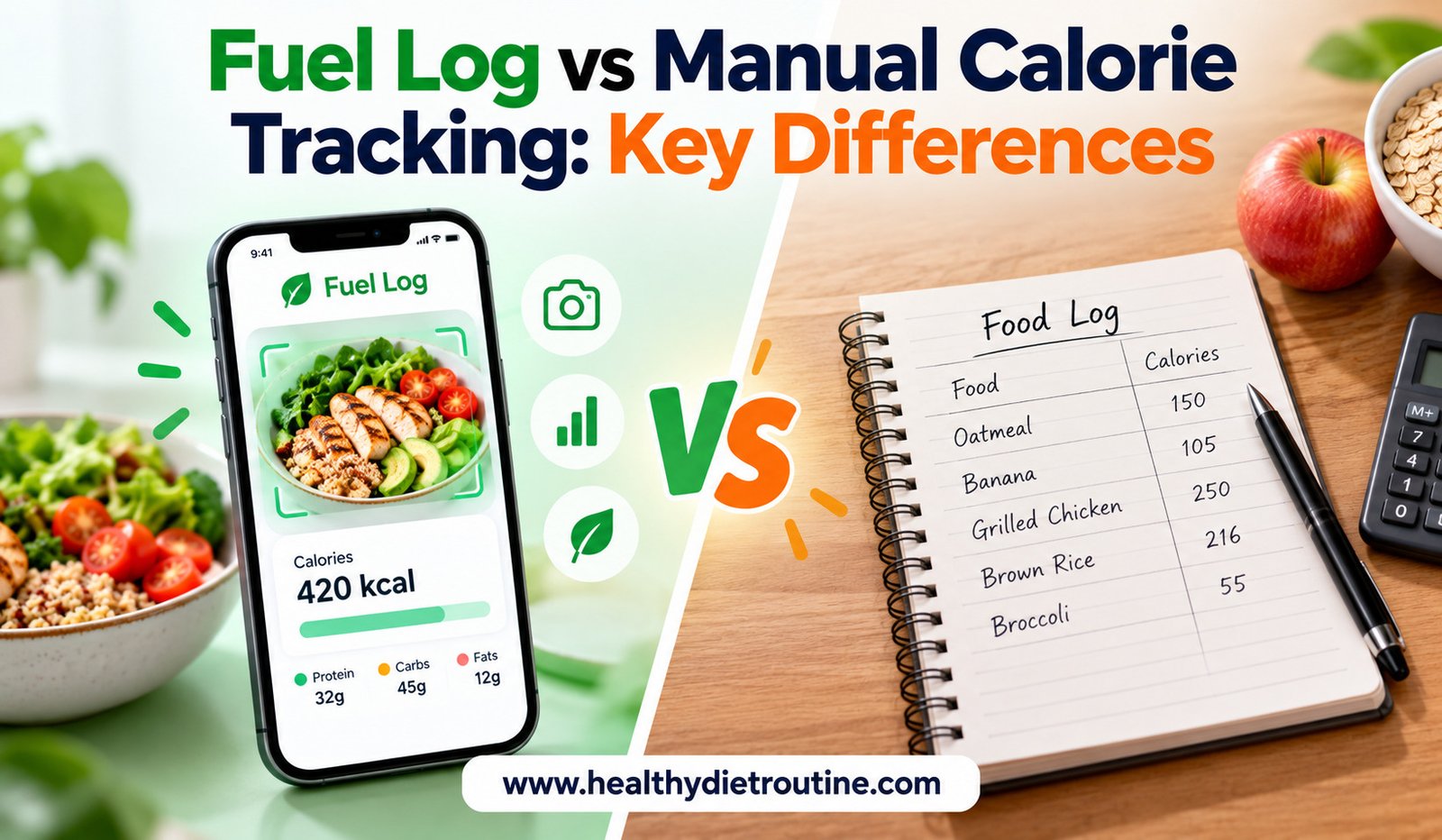
Tracking food intake can be useful for people who want to understand their eating habits, manage their calorie intake, or become more aware of their daily nutrition. However, the way people record food can make a big difference in how easy it is to stay consistent.
Traditional manual calorie tracking requires users to enter foods, search nutrition databases, estimate portions, and record each meal themselves. Newer tools such as Fuel Log aim to simplify this process by using technology to make food tracking faster and more convenient.
Both approaches have advantages. Manual tracking can provide a high level of control, while automated or AI-assisted systems can reduce repetitive work. Understanding the differences can help users decide which method fits their lifestyle.
What Is Manual Calorie Tracking?
Manual calorie tracking is the traditional approach to recording food consumption.
A user typically searches for each food in a calorie-tracking application or nutrition database. They then select the appropriate food, enter the serving size, and record it in their daily food diary.
For a simple meal, this may take only a few seconds. However, meals with multiple ingredients can require considerably more effort.
For example, recording a homemade meal may involve entering rice, vegetables, cooking oil, spices, sauces, and other ingredients separately. Users also need to estimate or measure how much of each ingredient they consumed.
The main advantage is control. The person logging the food decides what information to enter and can make detailed adjustments when accurate measurements are available.
The downside is that manual tracking can become repetitive.
What Is Fuel Log?
Fuel Log represents a more streamlined approach to food logging, designed to make the process easier for users.
Instead of requiring every food item to be manually searched and entered, technology-assisted food tracking can help users record meals with fewer steps. Depending on the features available in a particular implementation, users may be able to provide meal information in a simpler format and receive organized nutritional estimates.
The purpose of this approach is not necessarily to eliminate user involvement. Rather, it reduces some of the repetitive work associated with traditional food diaries.
This can be especially helpful for people who want to track their meals consistently but find conventional calorie counting too time-consuming.
Fuel Log vs Manual Calorie Tracking
The biggest difference between the two approaches is how much work the user has to do.
Manual calorie tracking puts most of the responsibility on the user. Fuel Log-style tracking aims to automate or simplify parts of the process.
That difference affects convenience, speed, accuracy, and the overall experience.
1. Speed of Food Logging
Manual calorie tracking can be relatively quick when the food is already available in a database.
However, logging becomes slower when meals are customized or homemade. Users may need to search for individual ingredients and adjust serving sizes.
A streamlined food-tracking system can reduce the number of steps involved.
Instead of navigating through several database entries, users can potentially provide their meal information more naturally and let the system organize the data.
For people who eat several times a day, saving even a few minutes per meal can make a significant difference over weeks and months.
2. Convenience for Everyday Meals
Convenience is one of the strongest reasons people look for alternatives to manual tracking.
Manual logging requires remembering to record meals and finding the appropriate database entries. This can become particularly inconvenient when eating at restaurants, traveling, or preparing meals from multiple ingredients.
A more automated approach can make food journaling feel less like administrative work.
The simpler the process, the more likely users may be to continue tracking consistently.
Consistency is important because a food diary becomes more useful when it represents regular eating habits rather than only a few carefully tracked days.
3. Level of User Control
Manual calorie tracking has an important advantage: direct control.
Users can select specific foods, adjust quantities, change ingredients, and review exactly what has been recorded.
This can be useful for people who are comfortable reading nutrition labels and measuring portions.
Technology-assisted systems may provide more automation, but automation can sometimes mean that users need to review generated information and correct mistakes.
Therefore, people who prefer complete control over every entry may favor manual tracking, while those who prioritize convenience may prefer a more automated system.
4. Handling Homemade Food
Homemade meals are one of the more challenging areas of calorie tracking.
A database may contain a generic version of a particular dish, but the actual nutritional content can vary depending on ingredients and preparation methods.
For example, two bowls of the same curry may contain different amounts of oil, vegetables, cream, or other ingredients.
Manual tracking allows users to enter individual ingredients and quantities, which can provide a more customized estimate.
An automated system can simplify the process, but the quality of the estimate depends on how much information the user provides and how accurately the technology interprets it.
For this reason, users should review automated estimates rather than assuming they are perfectly accurate.
5. Portion Size Accuracy
Portion size is critical when estimating calories.
A system may correctly identify that someone ate rice, but it still needs to know approximately how much rice was consumed.
Manual tracking allows users to enter measured quantities, such as grams or milliliters. When accurate measurements are available, this can improve the reliability of the record.
Automated tools may estimate portions based on descriptions, images, or typical serving sizes.
These estimates can be convenient, but they should be treated as approximations.
The more precise the user’s input, the more useful the resulting nutritional information is likely to be.
6. Reducing Tracking Fatigue
One of the biggest challenges with manual calorie counting is tracking fatigue.
At first, entering every meal may feel motivating. After several weeks, however, repeatedly searching for foods and entering portions can become frustrating.
Some users eventually stop tracking altogether because the process feels like too much effort.
A simplified food log can reduce this burden.
By minimizing repetitive tasks, tools such as Fuel Log can make it easier to maintain a food journal over a longer period.
The goal is not necessarily to make tracking more detailed. It is to make tracking sustainable.
7. Learning Eating Patterns
Both manual and automated tracking can help users understand their eating habits.
Once enough information has been collected, users may notice patterns in meal timing, food choices, snacking, or overall calorie intake.
Automated systems may make these insights easier to organize by summarizing information and highlighting recurring patterns.
For example, a user might discover that they regularly consume more snacks in the evening or that their weekday meals are very different from their weekend meals.
These observations can be more useful than focusing on one individual meal.
8. Accuracy Depends on Input Quality
It is tempting to assume that newer technology is automatically more accurate than manual tracking.
That is not necessarily true.
An AI-assisted system can process information quickly, but it may misunderstand a meal, identify the wrong food, or estimate a portion incorrectly.
Manual tracking can also be inaccurate when users guess serving sizes or select an inappropriate database entry.
In both cases, accuracy depends on the quality of the information being recorded.
Users should review questionable entries and provide additional details whenever possible.
9. Which Method Requires More Effort?
Manual tracking generally requires more active participation.
Users must search for foods, select entries, enter portions, and make adjustments.
A simplified system aims to shift some of that workload from the user to the technology.
This makes Fuel Log-style tracking attractive to busy people who want the benefits of food awareness without spending significant amounts of time maintaining their diary.
However, people who enjoy detailed nutrition tracking may appreciate the additional control offered by manual logging.
10. Which One Is Better?
There is no universal winner.
Manual calorie tracking can be a good choice for users who want detailed control and are comfortable investing time in their food diary.
Fuel Log can be more appealing to users who value convenience and want to reduce the amount of repetitive data entry involved in tracking meals.
Some people may even benefit from combining both approaches. They could use automated tracking for everyday meals and manually adjust entries when they need greater precision.
This creates a balance between convenience and control.
How to Choose the Right Approach
Before choosing a tracking method, consider your daily routine.
If you enjoy weighing ingredients, reading nutrition labels, and maintaining detailed records, manual tracking may suit you.
If you frequently eat on the go, have a busy schedule, or find traditional calorie tracking tedious, a more automated approach may be easier to maintain.
You should also consider your reason for tracking. Someone who simply wants a general understanding of eating habits may not need the same level of precision as someone following a professionally designed nutrition plan.
If you have specific dietary or medical requirements, it is better to discuss nutrition goals with a qualified healthcare professional rather than relying solely on automated calorie estimates.
Final Thoughts
Fuel Log and manual calorie tracking represent two different approaches to recording food intake.
Manual tracking provides detailed control but requires users to spend more time entering foods, checking portions, and maintaining their diary. A technology-assisted approach aims to simplify these tasks and make everyday food logging more convenient.
The most important factor is not which method has the most features. It is whether the approach is practical enough for you to use consistently.
For some people, detailed manual tracking will remain the preferred option. For others, automation can remove enough friction to make food logging a sustainable habit.
Ultimately, the best food-tracking method is one that provides useful information without making the process unnecessarily difficult. Whether you choose manual calorie counting, Fuel Log, or a combination of both, accurate inputs, realistic expectations, and consistency are more valuable than chasing perfect numbers.