
Smart Scale vs Regular Weighing Scale: Which One Should You Buy?
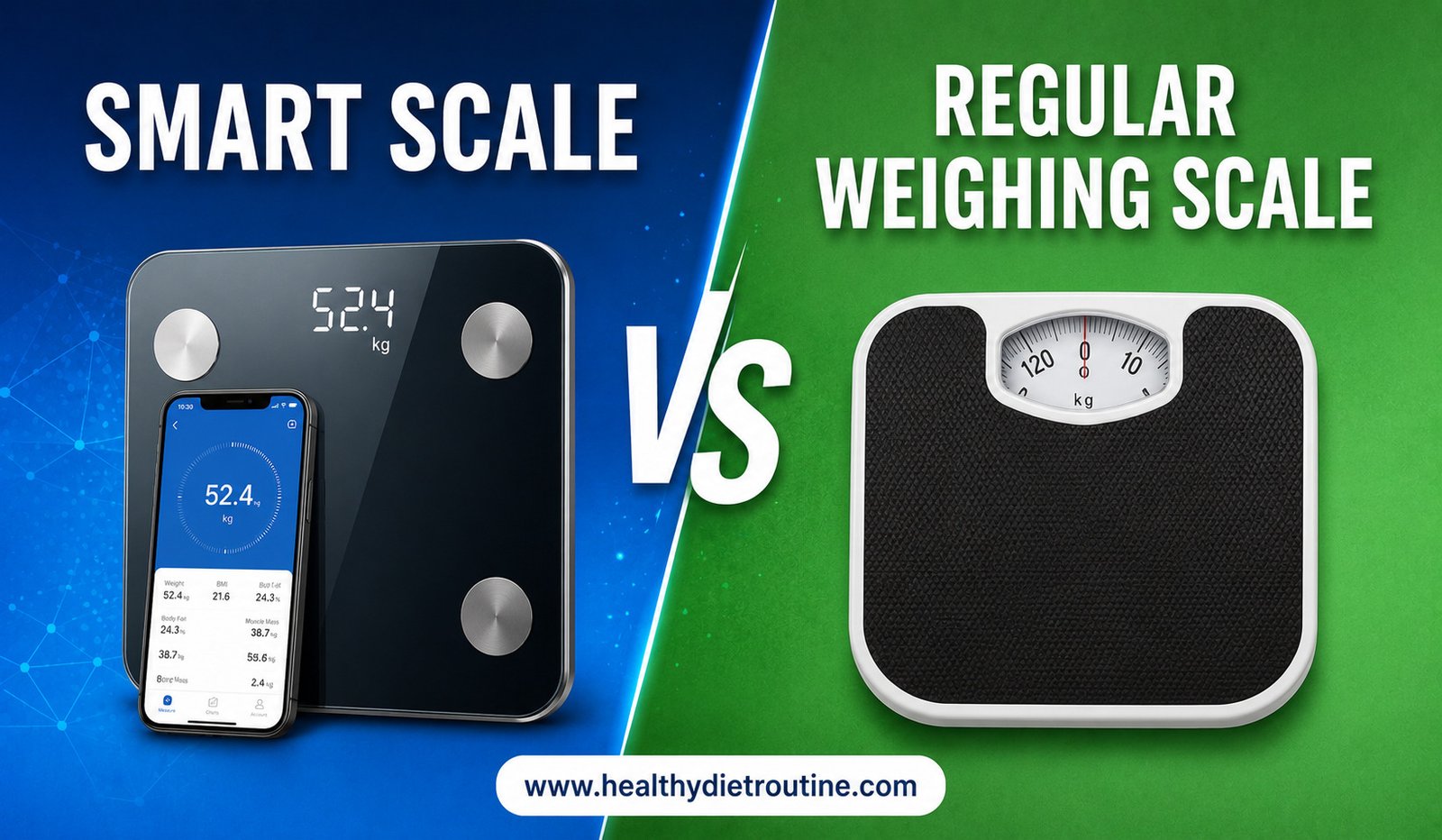
A weighing scale is one of the simplest tools for tracking body weight at home. For decades, regular digital weighing scales have provided a straightforward answer to one basic question: How much do you weigh? Today, however, smart scales offer considerably more information, including body composition estimates, app connectivity, and long-term progress tracking.
This has created a common question for buyers: smart scale vs regular weighing scale which one is better?
The answer depends on what you want from a scale. If you only need your current body weight, a regular digital scale may be all you need. If you enjoy tracking fitness trends and want additional measurements in a smartphone app, a smart scale can offer more functionality.
Let’s compare both options to help you decide which is right for your home.
What Is a Regular Weighing Scale?
A regular weighing scale is primarily designed to measure body weight. Modern digital versions usually have an electronic sensor and an easy-to-read display.
Unlike older mechanical scales, digital models can provide measurements in small increments and often turn on automatically when you step onto the platform.
Their biggest advantage is simplicity. You step on the scale, wait a moment, and read the number. There is no app, account, Bluetooth connection, Wi-Fi setup, or smartphone required.
For people who simply want to check whether their weight is changing over time, this straightforward approach can be more than enough.
What Is a Smart Scale?
A smart scale is a connected weighing device that measures body weight and may estimate additional body-composition metrics.
Depending on the model, these measurements can include body mass index (BMI), body-fat percentage, muscle mass, body water, bone mass, and other estimates. The scale can then transfer information to a smartphone application through Bluetooth or Wi-Fi.
Instead of seeing one number on the display, you can view your measurements over days, weeks, or months.
This makes smart scales particularly appealing to people who enjoy data-driven fitness tracking.
However, there is an important distinction: weight measurement and body-composition estimates are not equally reliable. Smart scales commonly use bioelectrical impedance analysis (BIA) for body-composition estimates, and these numbers can be affected by hydration, food intake, exercise, and other factors.
Smart Scale vs Regular Scale: Main Difference
The simplest way to understand the difference is this:
A regular scale measures weight. A smart scale measures weight and can provide additional estimated body-composition information while recording your data digitally.
That additional functionality is useful for some people but unnecessary for others.
If your main goal is to know whether you weigh 65 kg or 70 kg, paying extra for a connected scale may not provide much benefit.
On the other hand, if you want to see how your weight changes alongside other fitness metrics, a smart scale can make tracking more convenient.
Accuracy: Which Scale Is More Accurate?
When it comes to basic body weight, both good-quality regular and smart digital scales can provide useful measurements.
The smart features do not automatically make a scale more accurate. In fact, the additional body-composition measurements should be interpreted more cautiously.
BIA works by sending a small electrical current through the body and using the resulting impedance to estimate body composition. Hydration and other variables can influence the calculation.
This means a smart scale might show a body-fat percentage that changes from one day to another even when your actual body composition has not changed significantly.
For this reason, smart-scale body-composition numbers are generally more useful for observing long-term trends under consistent conditions than treating each reading as an exact measurement.
Body Weight Tracking
For basic weight tracking, there is little reason to choose a smart scale solely because it is “smart.”
A regular scale can do the job effectively.
If you weigh yourself at approximately the same time and under similar conditions, you can manually record the results in a notebook, spreadsheet, or smartphone application.
Smart scales simply automate much of this process. They can save measurements automatically and create graphs, reducing the effort required to track changes.
Body Composition Features
This is where smart scales have their biggest advantage.
Many smart models provide estimates for metrics beyond body weight. Depending on the device, you may see body-fat percentage, skeletal muscle, body water, visceral-fat estimates, BMI, and other measurements.
These numbers can provide additional context when following a fitness routine.
However, they should not be treated as clinical measurements. If you need accurate body-composition assessment for medical, athletic, or other professional reasons, a qualified healthcare professional can recommend more appropriate testing methods.
The advantage of a smart scale is primarily convenience and trend tracking, not medical-level precision.
Smartphone Connectivity
Regular weighing scales generally keep everything on the device itself.
Smart scales can connect to smartphone applications and automatically store measurements. Some can integrate with health and fitness platforms, allowing weight data to appear alongside exercise, sleep, or other information.
This can be helpful if you already use a fitness tracker or smartwatch.
For example, instead of manually entering your weight after every measurement, the smart scale can synchronize the information automatically.
If you rarely use health apps, however, this feature may not matter much to you.
Multiple User Profiles
Smart scales can be particularly useful in households where several people use the same device.
Many models can recognize or support multiple users and keep their measurements separate in the companion application.
A regular scale can also be shared, of course, but it does not automatically organize everyone’s history.
For families interested in tracking individual progress, smart-scale profiles can be a convenient feature.
Battery Life and Maintenance
Both regular digital scales and smart scales generally require batteries.
A smart scale may consume more power because it has additional electronics and wireless connectivity. Battery life varies significantly depending on the model, connection method, and frequency of use.
A regular scale is typically simpler and therefore has fewer things that can go wrong.
Smart scales also depend on software and smartphone applications. If an app changes, loses support, or becomes incompatible with a future phone, some connected features may become less useful.
This is worth considering before buying a smart device.
Privacy and Data Considerations
Smart scales collect more information than traditional weighing scales.
Because measurements can be transmitted to an application or cloud service, buyers should pay attention to the manufacturer’s privacy policies and data-handling practices.
A regular scale has a clear advantage in this area because it does not need an online account or connected application.
If you prefer to keep health and fitness information offline, a regular scale may be the more comfortable choice.
Which Is Better for Weight Loss?
Both can support weight-management goals, but neither scale will cause weight loss on its own.
A regular scale can provide the essential feedback needed to monitor weight changes. For some people, that simple approach is actually preferable because it avoids becoming distracted by numerous metrics.
A smart scale can be useful if you enjoy detailed tracking and want to monitor trends automatically.
However, don’t become overly focused on daily fluctuations. Body weight naturally changes because of hydration, food intake, sodium, exercise, and other factors.
Looking at broader trends over several weeks is generally more informative than reacting to every single measurement.
Which Is Better for Fitness Tracking?
For basic fitness tracking, a smart scale can complement a smartwatch or fitness band.
You might use a wearable to track activity and workouts while using the smart scale to track weight trends. Having both devices connected to the same health platform can make your data easier to review.
Still, you do not need a smart scale to maintain a successful fitness routine. A regular scale can provide the weight information you need, while other fitness metrics can be tracked separately.
Price Difference
Regular digital weighing scales are generally less expensive because they have fewer components and functions.
Smart scales can cost more because of additional sensors, wireless connectivity, displays, applications, and body-composition features.
Before spending extra money, ask yourself whether you will actually use those features.
If you want a scale for occasional household weighing, a regular digital model may provide better value.
If you plan to monitor fitness progress regularly and enjoy reviewing data through an app, paying more for a smart model may be worthwhile.
Who Should Buy a Regular Weighing Scale?
A regular digital weighing scale is a good choice if you:
- Only need body-weight measurements
- Want a simple device with minimal setup
- Prefer not to use smartphone apps
- Want to spend less
- Do not need body-composition estimates
- Prefer keeping measurements offline
For many households, this is all that is necessary.
Who Should Buy a Smart Scale?
A smart scale may be more suitable if you:
- Enjoy tracking fitness data
- Want automatic weight-history records
- Use a smartwatch or fitness application
- Want estimated body-composition metrics
- Share the scale with multiple household users
- Like viewing progress through graphs and trends
The key is to buy it for the convenience and tracking ecosystem rather than assuming every additional measurement is perfectly accurate.
Tips for Getting Consistent Measurements
Regardless of which type of scale you choose, consistency matters.
Place the scale on a hard, level surface rather than a thick carpet. Try to weigh yourself at a similar time of day and under similar conditions.
If you are using a smart scale for body-composition estimates, following the manufacturer’s instructions is particularly important. Hydration and other factors can influence BIA results, so comparing measurements taken under similar circumstances can make trends easier to interpret.
Avoid interpreting a single unusual measurement as a major change in your health or fitness.
Final Verdict: Smart Scale or Regular Scale?
So, smart scale vs regular weighing scale which should you buy?
Choose a regular digital weighing scale if you want something simple, affordable, and focused on body weight. It is reliable for its primary purpose and does not require apps, accounts, or connectivity.
Choose a smart scale if you want automatic tracking, smartphone integration, multiple-user profiles, and additional body-composition estimates. It can be a useful part of a broader fitness-tracking setup.
The most important thing is not how advanced the scale is. It is whether the device fits your goals and whether you use it consistently.
For someone who simply wants to monitor weight, a regular scale can be the smarter purchase. For someone who enjoys connected fitness technology and long-term data tracking, a smart scale may be worth the extra investment.
Ultimately, the best weighing scale is the one that gives you useful information without making your health routine unnecessarily complicated.