
Massage Gun vs Foam Roller: Which Is Better?
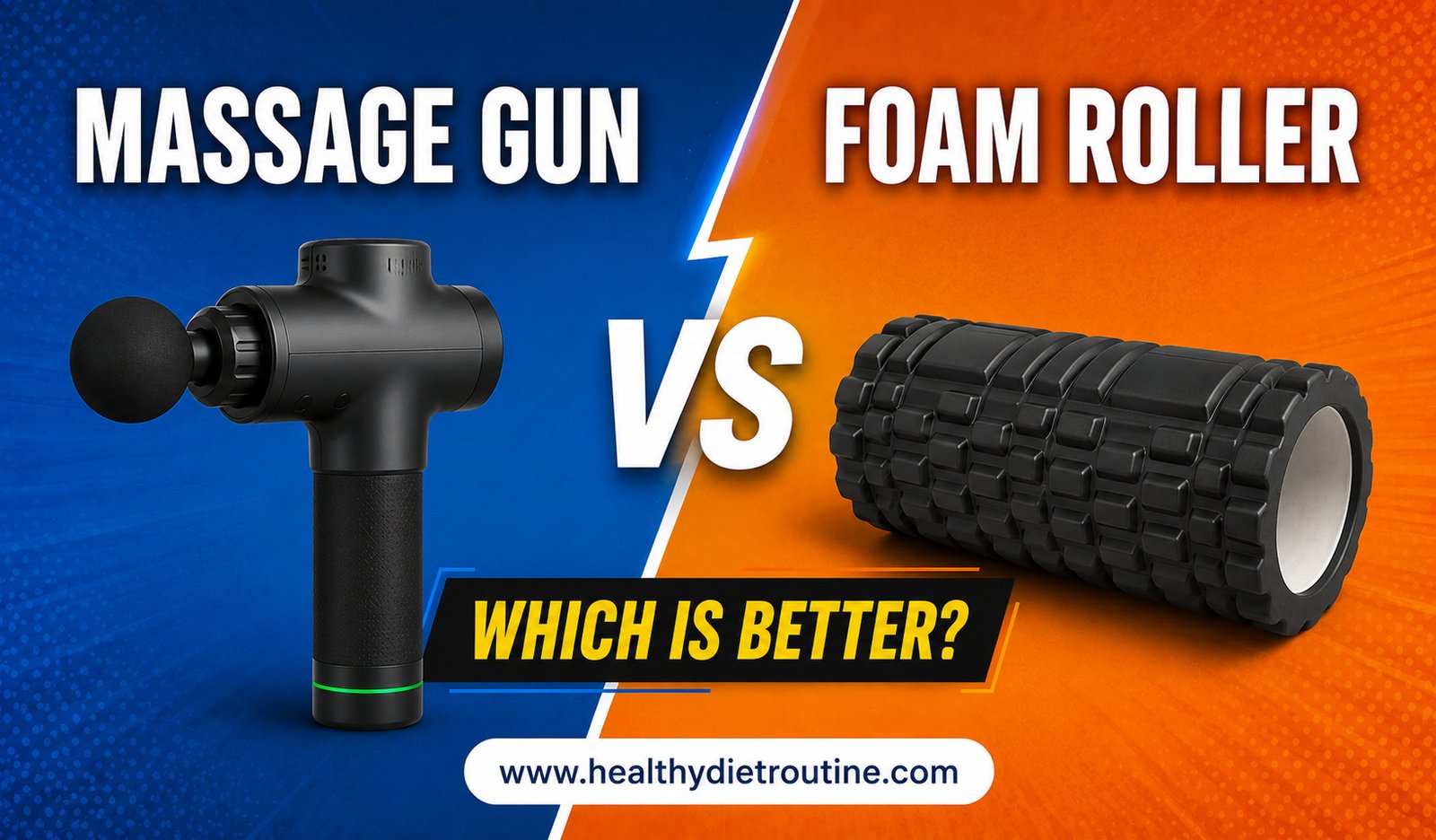
Recovery has become an important part of modern fitness routines. Whether you exercise at home, train at the gym, run outdoors, or simply spend long hours sitting at a desk, tight muscles can affect how you feel and move. Two popular tools for managing everyday muscle tightness are massage guns and foam rollers.
Both are designed to provide a form of self-massage, but they work in very different ways. A massage gun uses rapid percussive movements against the body, while a foam roller allows you to apply pressure to larger areas of muscle by moving your body over a cylindrical surface.
So, when comparing a massage gun vs foam roller, which one is better?
There is no universal winner. The right option depends on your recovery goals, budget, preferred experience, portability needs, and the areas of your body you want to target.
What Is a Massage Gun?
A massage gun is a handheld electronic device with a motorized head that moves rapidly back and forth. This creates a percussive sensation when the attachment is placed against a muscle.
Different models offer multiple speed levels and interchangeable heads designed for different areas of the body. Users commonly apply massage guns to areas such as the thighs, calves, glutes, shoulders, and back.
Massage guns are particularly popular because they can target a specific area without requiring much physical effort. Instead of rolling your body across a foam roller, you simply hold the device and guide it over the desired muscle.
Research suggests that percussive therapy may temporarily improve flexibility and range of motion and reduce feelings of muscle soreness, although it should not be viewed as a substitute for medical treatment or proper recovery.
What Is a Foam Roller?
A foam roller is a cylindrical piece of foam used for self-myofascial release. You place the roller underneath a body area and use your body weight to apply pressure while slowly moving back and forth.
Foam rollers are available in different densities, lengths, and surface patterns. Some are smooth, while others have ridges or textured sections.
They can be used on larger muscle groups, including the quadriceps, hamstrings, calves, glutes, and upper back.
Foam rolling is often incorporated into warm-ups and cooldowns because it can provide a convenient way to apply pressure to muscles without requiring another person.
Massage Gun vs Foam Roller: How Are They Different?
The biggest difference is how pressure is delivered.
A foam roller uses your body weight and movement to apply sustained pressure across a relatively broad area. A massage gun delivers rapid mechanical pulses to a smaller area.
This means the two tools can feel completely different even when they are being used on the same muscle.
A foam roller may be better when you want broad muscle coverage, while a massage gun can be useful when you want more precise targeting.
Which Is Better for Muscle Soreness?
Both can be useful for temporary relief from post-exercise discomfort.
Foam rolling can help reduce the sensation of muscle soreness and may temporarily improve range of motion. Research reviews have found that foam rolling can be a useful recovery strategy without significantly harming athletic performance when used appropriately.
Massage guns may provide a similar short-term benefit through percussive stimulation. Cleveland Clinic notes that massage guns can be used to help loosen muscles and potentially improve blood flow, flexibility, and range of motion.
Neither tool should be expected to instantly repair muscle damage or eliminate soreness completely.
Which Provides Better Targeted Massage?
This is where a massage gun generally has the advantage.
The small head of a massage gun allows you to focus on a particular muscle or area. You can move slowly over a tight spot and adjust the intensity according to your comfort.
A foam roller covers a wider area, making it harder to isolate one small section.
For athletes who frequently experience tight calves, glutes, shoulders, or other specific areas, the precision of a massage gun can be particularly convenient.
However, precision does not mean you should apply maximum pressure to every tight spot. More intensity is not necessarily better.
Which Is Better for Large Muscle Groups?
A foam roller is often more practical for large muscle groups.
Rolling your thighs, hamstrings, calves, or glutes over a longer foam roller allows you to cover a substantial area in a relatively short period.
With a massage gun, you have to move the device manually across the muscle. This can take longer when treating large areas.
If your recovery routine frequently focuses on your legs after running or strength training, a foam roller can be a simple and effective option.
Portability
Massage guns are generally compact enough to carry in a gym bag, although their size and weight vary considerably.
Foam rollers can be more awkward to transport because of their cylindrical shape. Full-size rollers take up more space, although compact travel rollers are available.
For people who travel regularly or want a recovery tool they can use at work or the gym, a compact massage gun may be more convenient.
Ease of Use
Neither tool requires professional training for basic use, but each has a learning curve.
Foam rolling is straightforward, but finding a comfortable position and controlling your body weight can take some practice.
Massage guns are easier to maneuver but require awareness of where and how strongly you apply the device. The user manual should be followed, particularly regarding speed, attachment selection, and recommended areas.
A massage gun should generally be moved slowly over muscle rather than held aggressively against one painful point for an extended period.
Which Is More Affordable?
Foam rollers generally win on price.
A basic foam roller is relatively inexpensive and does not require batteries, charging, or replacement electronic components. This makes it an accessible recovery tool for beginners.
Massage guns range from relatively affordable entry-level models to expensive premium devices. Higher-priced models may offer stronger motors, quieter operation, more attachments, better battery life, and improved build quality.
If you are starting a recovery routine and have a limited budget, a foam roller can provide excellent value.
Which Is Better for Beginners?
A basic foam roller is often a good first recovery tool because it is simple and inexpensive.
It teaches you how different amounts of pressure feel and encourages you to pay attention to muscle tightness and movement.
A massage gun can also be beginner-friendly, but users should start with a low intensity and become familiar with the device before increasing speed or pressure.
The goal should be comfortable stimulation rather than pain.
Which Is Better Before a Workout?
Both tools can be used before exercise, but they should be used differently from a long recovery session.
Foam rolling before exercise may help temporarily improve range of motion. Research has found that short-duration foam rolling can increase flexibility without necessarily reducing subsequent athletic performance.
A massage gun can also be used briefly before training to stimulate muscles and prepare specific areas for movement.
Neither should replace an appropriate warm-up that includes gradually increasing activity and movement specific to your workout.
Which Is Better After a Workout?
After exercise, both can fit into a recovery routine.
A foam roller is useful for slowly working across large muscle groups. A massage gun can be used when you want to target particular muscles.
You do not need to spend a long time using either tool. A short, comfortable session may be sufficient for many people.
Recovery should also include adequate sleep, hydration, nutrition, rest, and sensible training progression.
Safety: When Should You Avoid Them?
Massage guns and foam rollers are not appropriate for every situation.
Avoid using either tool directly over open wounds, bruises, areas of significant swelling, or painful injuries. Massage guns should not be used over bones, joints, the front of the neck, or other sensitive areas. Cleveland Clinic recommends avoiding areas with significant pain or injury and checking with a healthcare professional if you have concerns.
Foam rollers should also not be aggressively used over injured areas.
If you have a medical condition, recent injury, unexplained persistent pain, or are unsure whether self-massage is appropriate, consult a qualified healthcare professional before using these tools.
Massage Gun vs Foam Roller: Which Is Better for Home Use?
For home recovery, the choice depends largely on your habits.
A foam roller is ideal if you want an affordable, equipment-free recovery tool that can cover large muscle groups.
A massage gun is more suitable if you value portability, targeted pressure, and adjustable intensity.
Some people eventually choose to own both because they serve different purposes. A foam roller can handle broad areas such as the thighs and back, while a massage gun can be used for more targeted work.
Can You Use Both Together?
Absolutely. A combination can provide a flexible recovery routine.
For example, you could use a foam roller for a few minutes across your larger leg muscles and then use a massage gun briefly on specific areas that feel particularly tight.
The key is to avoid overdoing it. Self-massage should feel manageable and comfortable. Aggressive pressure can leave muscles feeling more irritated rather than better.
Final Verdict
So, massage gun vs foam roller which is better?
If you want targeted massage, portability, and adjustable intensity, a massage gun is likely the better choice. It is especially convenient for people who regularly exercise and want to focus on specific muscles.
If you want affordability, simplicity, and broad muscle coverage, a foam roller is hard to beat. It requires no charging and can become a useful part of both warm-up and recovery routines.
For many fitness users, there is no reason to choose only one. A foam roller and massage gun can complement each other rather than compete.
Ultimately, the best recovery tool is the one you can use comfortably and consistently. Neither device is a magic solution for soreness or injury, but when combined with sensible training, adequate rest, and good recovery habits, both can be useful additions to a home fitness routine.