Simple Flexibility Exercises for Beginners
Flexibility is an important part of overall physical fitness, but it is often overlooked. Many people focus on strength or cardio workouts while forgetting that comfortable movement through a useful range of motion can make everyday activities easier.
The good news is that you do not need advanced yoga skills or expensive equipment to begin working on flexibility. Simple stretches can be performed at home with little space and can be adapted to different fitness levels.
For beginners, the goal is not to force the body into extreme positions. Instead, focus on gentle, controlled movements and gradually improve your range of motion over time.
What Is Flexibility?
Flexibility refers to the ability of your muscles and joints to move through a range of motion. Everyone has a different natural level of flexibility, and it can be influenced by factors such as age, activity level, previous injuries, and individual body structure.
Regular stretching can help you become more comfortable with certain movements. However, flexibility training should be gradual. You should never need to force a stretch or push through sharp pain.
A balanced fitness routine can combine flexibility exercises with strength, cardiovascular activity, and mobility work.
1. Neck Tilts
Neck tilts are a gentle way to begin a stretching routine.
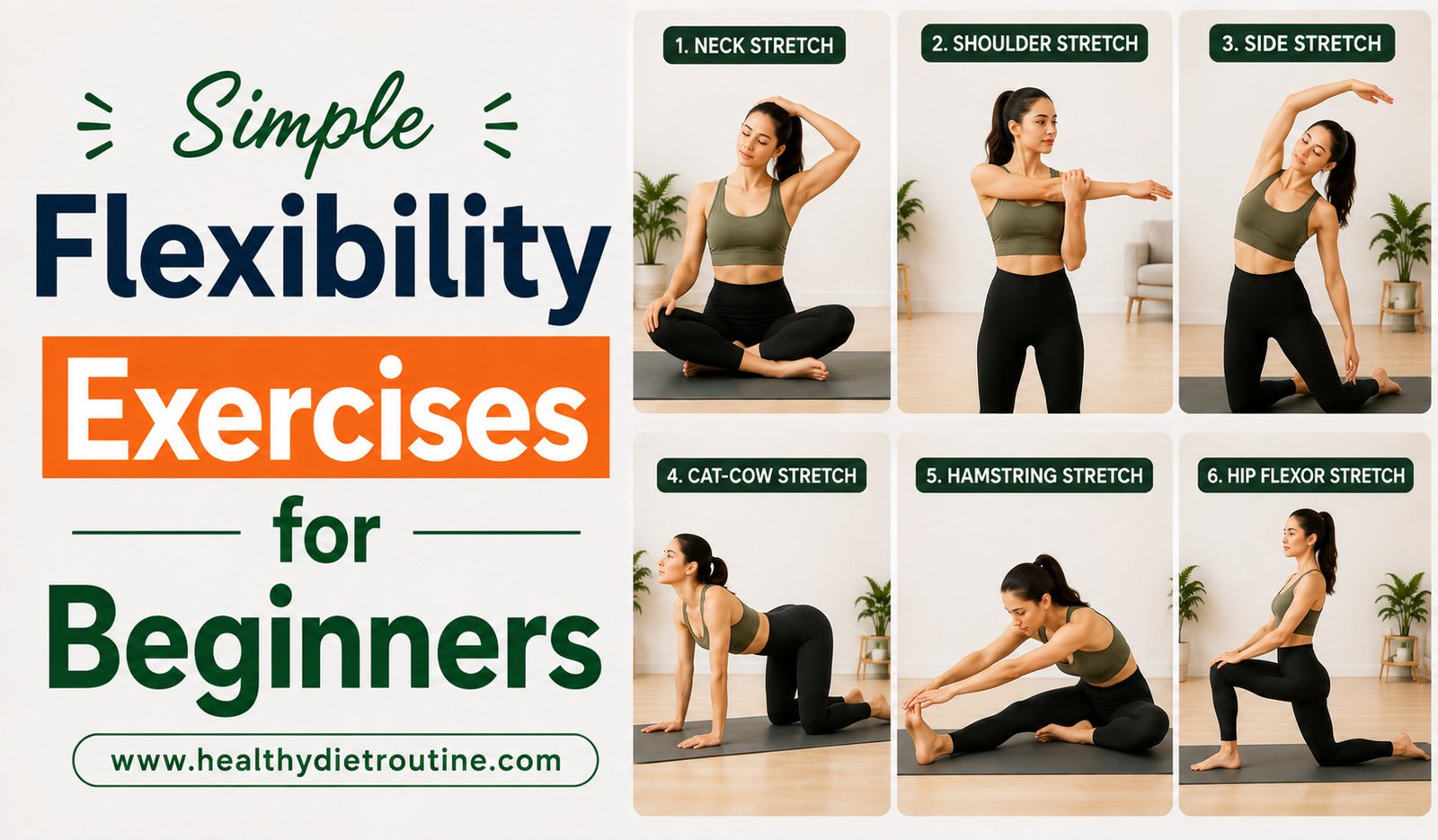
Sit or stand upright and slowly tilt your head toward one shoulder. Keep the movement comfortable and avoid lifting the shoulder toward your ear. Return to the center and repeat on the other side.
Hold each comfortable position for around 10–20 seconds.
Avoid making large circles with your neck or forcing the head backward.
2. Shoulder Rolls
Shoulder rolls can help you gently move the shoulders through a comfortable range.
Stand or sit upright. Slowly roll your shoulders upward, backward, and downward. Repeat several times, then reverse the direction.
Try 8–10 repetitions in each direction.
Keep the movement smooth and relaxed rather than trying to make very large circles.
3. Chest Stretch
A simple chest stretch can be useful if you spend a lot of time sitting at a desk.
Stand near a doorway and place your forearms or hands against the frame, depending on your comfort. Gently move your body forward until you feel a mild stretch across the chest.
Hold for 15–30 seconds while breathing normally.
Do not force your shoulders into an uncomfortable position.
4. Cross-Body Shoulder Stretch
Bring one arm across your chest. Use your other arm to gently support it near the upper arm.
Hold the stretch for 15–30 seconds, then switch sides.
Keep your shoulders relaxed and avoid pulling aggressively.
This is a simple stretch that can fit into a short office break or home workout.
5. Cat-Cow Stretch
Cat-cow is a gentle movement that involves the spine and can be useful as part of a warm-up or mobility routine.
Start on your hands and knees. Slowly round your back upward, then gently move into a comfortable extended position while keeping your movement controlled.
Repeat for 6–10 cycles.
Move according to your own range rather than trying to create an exaggerated curve.
6. Child’s Pose
Child’s pose is commonly used in yoga and can provide a gentle stretch for the back, hips, and legs.
Start on your hands and knees and gradually move your hips backward toward your heels. Extend your arms forward or keep them closer to your body, depending on what feels comfortable.
Hold the position for 20–30 seconds while breathing naturally.
If your hips do not comfortably reach your heels, place a cushion or folded towel underneath you for support.
7. Seated Hamstring Stretch
Sit on the floor with one leg extended and the other leg comfortably bent.
Keep your back as relaxed and upright as possible and gently lean toward the extended leg. You should feel a mild stretch along the back of the thigh.
Hold for 15–30 seconds and switch sides.
You do not need to touch your toes. Reaching only as far as comfortable is enough.
8. Standing Quadriceps Stretch
The quadriceps are the muscles at the front of your thighs.
Stand near a wall or sturdy surface for balance. Bend one knee and bring your heel toward your body. Hold your ankle or foot if you can do so comfortably.
Keep your knees relatively close together and avoid pulling the foot aggressively.
Hold for 15–30 seconds before switching sides.
If balancing on one leg is difficult, use support throughout the stretch.
9. Calf Stretch Against a Wall
Calf stretches are easy to perform and require very little space.
Stand facing a wall and place your hands against it. Step one foot backward while keeping that heel on the floor. Gently bend the front knee and lean toward the wall.
You should feel a stretch in the calf of the back leg.
Hold for 15–30 seconds, then switch sides.
10. Hip Flexor Stretch
The hip flexors can become tight when you spend long periods sitting.
Start in a comfortable half-kneeling position with one knee on the floor and the other foot in front. Keep your torso upright and gently move your hips forward.
Hold for 15–30 seconds and switch sides.
Do not push your hips forward aggressively. The stretch should remain comfortable.
11. Butterfly Stretch
Sit on the floor and bring the soles of your feet together. Allow your knees to move outward naturally.
Hold your feet or ankles and sit as upright as comfortable. You can gently lean forward if you want a deeper stretch.
Hold for 20–30 seconds.
Do not force your knees toward the floor with your hands.
12. Gentle Spinal Twist
A seated spinal twist can introduce gentle rotation into your routine.
Sit comfortably with your legs positioned according to your flexibility. Slowly rotate your upper body toward one side while keeping your movement controlled.
Hold for 10–20 seconds and repeat on the other side.
Avoid forcing the rotation or using your arms to aggressively pull yourself farther.
13. Ankle Circles
Ankle mobility is useful for everyday walking and lower-body movements.
Sit or stand with support and slowly rotate one ankle in a circle. Complete several rotations in one direction and then reverse.
Repeat with the other ankle.
Try 8–10 circles per direction.
Keep the movement slow and comfortable.
14. Standing Side Stretch
Stand upright with your feet comfortably apart. Raise one arm overhead and gently lean your upper body toward the opposite side.
You should feel a mild stretch along the side of your torso.
Hold for 15–20 seconds, return to the center, and switch sides.
Keep both feet grounded and avoid bending forward or backward.
A Simple Beginner Flexibility Routine
You do not need to perform every stretch in one session. A simple routine could include:
- Shoulder rolls – 8–10 repetitions
- Cross-body shoulder stretch – 15–30 seconds per side
- Cat-cow – 6–10 cycles
- Hip flexor stretch – 15–30 seconds per side
- Seated hamstring stretch – 15–30 seconds per side
- Calf stretch – 15–30 seconds per side
- Butterfly stretch – 20–30 seconds
- Gentle spinal twist – 10–20 seconds per side
Move slowly between stretches and breathe normally.
When Is the Best Time to Stretch?
Flexibility exercises can be included at different times depending on the type of movement.
Gentle dynamic movements, such as shoulder rolls, marching, and controlled leg movements, can work well as part of a warm-up before exercise.
Longer static stretches are often more comfortable when your muscles are already warm, such as after a workout or following several minutes of light activity.
You can also perform gentle flexibility work as a separate session when your body is comfortably warmed up.
Common Stretching Mistakes
One of the most common mistakes beginners make is stretching too aggressively. A stretch should generally feel mild to moderate, not painful.
Another mistake is bouncing repeatedly while holding a static stretch. Smooth, controlled movement is usually a better approach.
Holding your breath is another common issue. Try to breathe naturally and relax into the movement.
Finally, do not compare your flexibility with someone else’s. Your starting point is individual, and progress can take time.
How to Improve Flexibility Gradually
Consistency is more important than forcing a deeper stretch. Practicing several times each week can help you become more comfortable with different movements.
Keep track of small improvements. You might notice that you can reach slightly farther, move more comfortably, or maintain a position with less tension.
Do not expect dramatic changes immediately. Flexibility develops gradually, and progress can vary from person to person.
Safety Tips for Beginners
Choose a comfortable, stable surface and make sure you have enough space to move.
Never force a stretch or hold a position that causes sharp pain, numbness, or unusual discomfort. If you have an injury, joint problem, or health condition that affects movement, consider getting advice from a qualified healthcare or physical therapy professional before beginning a new flexibility routine.
Final Thoughts
Simple flexibility exercises for beginners can be an easy addition to your everyday fitness routine. Neck tilts, shoulder stretches, hamstring stretches, calf stretches, hip flexor stretches, cat-cow, butterfly stretches, and gentle spinal movements require little equipment and can be adapted to different ability levels.
The goal is not to become extremely flexible overnight. Focus on comfortable movement, regular practice, and gradual progress.
When combined with strength training, cardiovascular activity, and everyday movement, flexibility exercises can help you develop a more balanced and sustainable approach to physical fitness.