
Air Purifier vs Air Quality Monitor: What’s the Difference?
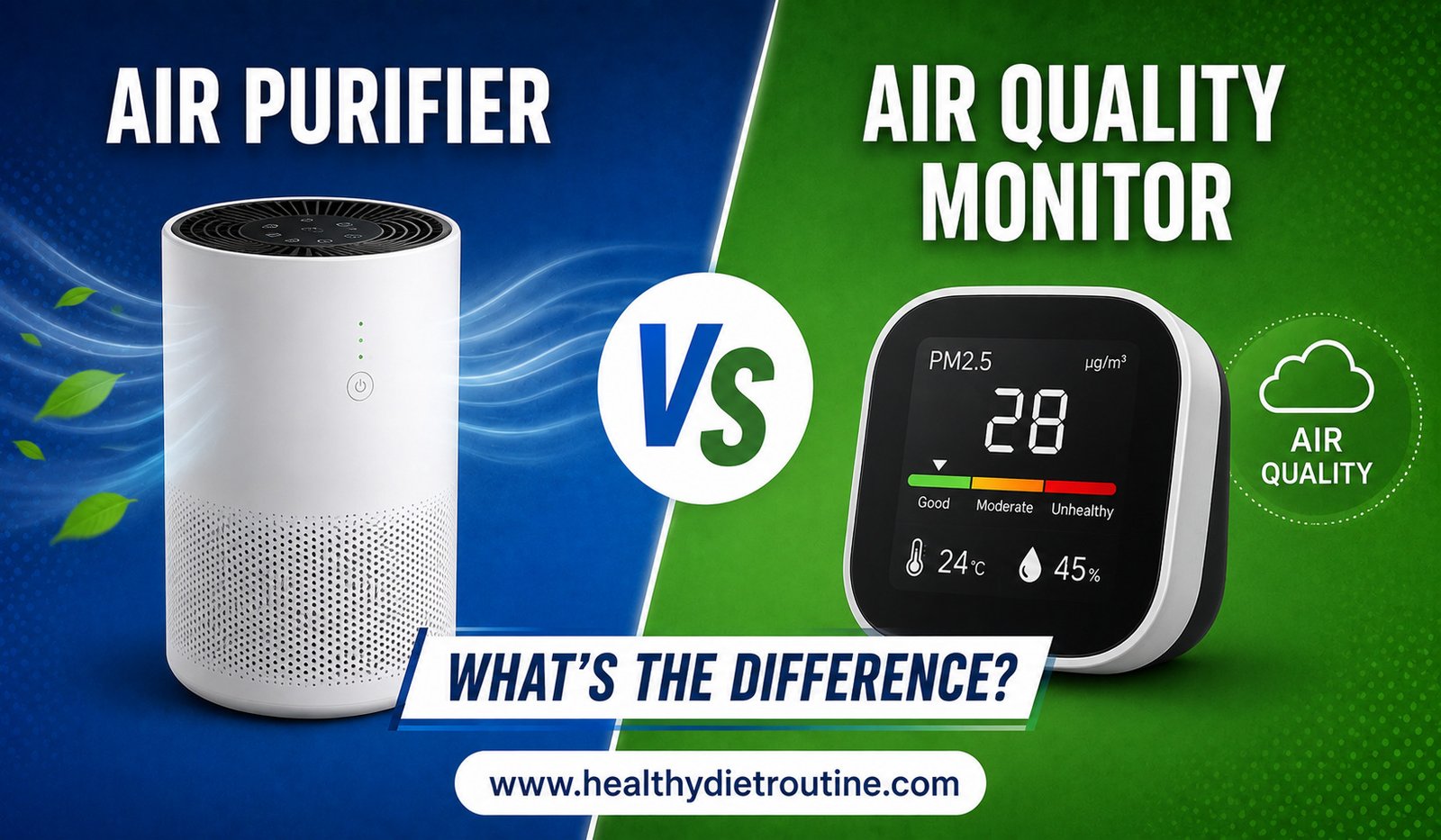
Indoor air quality has become an important consideration for modern homes, particularly in bedrooms, living rooms, offices, and other enclosed spaces. Dust, smoke, pollen, pet dander, and other airborne particles can affect how clean the air feels. This has led many homeowners to consider devices designed to improve or monitor indoor air.
Two products often appear together when shopping for better indoor air quality: air purifiers and air quality monitors. Although their names may sound similar, they perform completely different jobs.
An air purifier is designed to clean the air, while an air quality monitor is designed to measure and report information about the air.
Understanding this difference is important because buying one does not automatically give you the benefits of the other.
What Is an Air Purifier?
An air purifier is an appliance that pulls indoor air through one or more filters or purification technologies and then releases treated air back into the room.
Many residential air purifiers use mechanical filtration, particularly high-efficiency particulate filters, to capture airborne particles. Depending on the model, additional filtration such as activated carbon may be included to help reduce certain odors and gaseous pollutants.
Some air purifiers also include sensors that monitor air quality and automatically adjust fan speed.
The main purpose remains simple: reduce certain pollutants from indoor air.
What Is an Air Quality Monitor?
An air quality monitor does not primarily clean the air. Instead, it measures specific characteristics or pollutants and displays the information to the user.
Depending on the device, an indoor air quality monitor may measure particulate matter such as PM2.5, carbon dioxide, volatile organic compounds (VOCs), temperature, and humidity.
Some advanced monitors can send information to a smartphone app, create historical charts, or provide alerts when readings change.
The main purpose is awareness. It tells you what is happening in your indoor environment so you can decide whether action is necessary.
Air Purifier vs Air Quality Monitor: The Main Difference
The simplest way to remember the difference is:
An air purifier changes the air. An air quality monitor measures the air.
A purifier can remove or reduce certain airborne pollutants but may not tell you exactly what is present.
A monitor can show you changes in indoor air quality but cannot generally remove those pollutants by itself.
For example, an air quality monitor may detect elevated PM2.5 levels after cooking. An air purifier with appropriate filtration can then be used to reduce airborne particles.
This is why the two devices can work well together.
How Does an Air Purifier Work?
The most common type of air purifier uses a fan to draw room air through a filter.
A properly designed high-efficiency particulate filter can capture a large proportion of airborne particles. The U.S. Environmental Protection Agency explains that portable air cleaners can help improve indoor air quality when appropriately sized and operated, particularly for particulate pollutants.
Some models also use activated carbon to address certain odors and gases.
The effectiveness of a purifier depends on several factors, including the filter technology, airflow rate, room size, operating speed, and how long the device runs.
Simply owning an air purifier does not guarantee clean air. It needs to be appropriately sized and maintained.
How Does an Air Quality Monitor Work?
Air quality monitors use sensors to detect specific environmental characteristics.
For example, a particle sensor may estimate the concentration of fine particles in the air. Other sensors can monitor carbon dioxide, humidity, temperature, or certain volatile organic compounds.
The monitor then displays the results through a screen or smartphone application.
This information can help identify patterns.
You might discover that particle levels increase while cooking, carbon dioxide rises when several people are in a closed room, or humidity becomes excessive during certain weather conditions.
An air quality monitor therefore turns an invisible environmental issue into measurable information.
Do You Need Both?
For many homes, using both devices can be more useful than choosing only one.
An air purifier can actively reduce certain pollutants, while an air quality monitor can show whether indoor conditions are changing.
For example, you might place a monitor in the bedroom and notice elevated particle levels. You can then operate the purifier and observe whether the readings decline.
This provides a basic feedback loop: measure, act, and monitor again.
However, not every household needs both. If your primary goal is simply reducing airborne particles, a suitable air purifier may be enough.
If your main goal is understanding indoor conditions before deciding what action to take, a monitor can be useful.
Air Purifier for Bedrooms
Bedrooms are one of the most common places to use an air purifier because people spend many hours there.
A purifier can help reduce airborne particles such as dust and other particulate matter, depending on its filtration system.
When choosing one for a bedroom, noise level is particularly important. A purifier that produces excessive noise may interfere with sleep.
Look for a model with a suitable room coverage rating, multiple fan speeds, a sleep mode, and readily available replacement filters.
Do not select a purifier solely because its manufacturer claims it is suitable for a very large room. Consider the actual airflow performance and the size of the space.
Air Quality Monitor for Bedrooms
An air quality monitor can be useful in a bedroom because it can provide information about particulate matter, carbon dioxide, humidity, and temperature, depending on the model.
Carbon dioxide is particularly interesting because it can increase in occupied rooms when ventilation is limited.
A monitor may therefore reveal that a bedroom has poor ventilation even if the room looks clean.
It can also help you understand how humidity changes throughout the night.
This information can guide practical decisions about ventilation, fans, air conditioning, or humidification.
What Does PM2.5 Mean?
PM2.5 refers to fine particulate matter with an aerodynamic diameter of 2.5 micrometers or smaller.
These tiny particles can come from sources such as combustion, smoke, cooking, and outdoor pollution entering the home.
A monitor capable of measuring PM2.5 can therefore provide useful information about particulate pollution.
A purifier with an effective particle filtration system can help reduce airborne particle concentrations.
However, air purification does not eliminate the source of pollution. If cooking smoke is causing elevated particle levels, for example, source control and ventilation remain important.
What About Carbon Dioxide?
Carbon dioxide is different from particulate pollution.
A typical particle filter can remove particles but does not remove carbon dioxide from a room.
If a monitor shows elevated CO₂, improving ventilation may be more relevant than simply increasing air-purifier speed.
This illustrates why air quality monitoring can be valuable. Different pollutants require different solutions.
Opening windows when outdoor air quality is poor may not always be helpful, while doing so when indoor CO₂ is high and outdoor conditions are favorable may improve ventilation.
Air Purifier Features to Look For
When buying an air purifier, focus on practical performance rather than a long list of marketing features.
Look for:
- Appropriate room coverage
- Effective particle filtration
- Good airflow or clean-air delivery performance
- Reasonable noise levels
- Easily available replacement filters
- Multiple fan speeds
- Automatic mode, if useful
- Energy-efficient operation
Activated carbon can be useful when odor and certain gaseous pollutants are a concern.
The EPA notes that air cleaners vary in their ability to remove different pollutants, so it is important to choose technology suited to the problem you are trying to address.
Air Quality Monitor Features to Look For
For an air quality monitor, the most important consideration is what you actually want to measure.
A basic monitor may track PM2.5, temperature, and humidity.
More advanced models may also measure CO₂, VOCs, formaldehyde, or other indicators.
Useful features include:
- Clear real-time display
- Historical data
- Smartphone connectivity
- Alerts
- Multiple sensor measurements
- Easy-to-understand readings
- Calibration information
Do not assume that a monitor measuring more pollutants is automatically better. Sensor quality and reliability matter more than the number of metrics listed on the packaging.
Can an Air Purifier Improve Air Quality Without a Monitor?
Yes.
An air purifier can operate without an air quality monitor. Many purifiers have built-in sensors that can automatically adjust fan speed, while basic models simply run at the speed selected by the user.
However, without an independent monitor, you may have less information about how the room’s air quality changes.
You may know that the purifier is running, but you will not necessarily know how particle concentrations or other conditions are changing.
Can an Air Quality Monitor Replace an Air Purifier?
No.
A monitor measures air quality; it does not generally remove pollutants.
If a monitor detects high particle levels, it can alert you to a problem, but you still need to address the source through ventilation, filtration, cleaning, or other appropriate measures.
This is the fundamental distinction between the two products.
Do Smart Air Purifiers Make a Difference?
Smart air purifiers can connect to smartphone apps and, in some cases, smart-home platforms.
These features can allow users to view air-quality information remotely, change fan speed, schedule operation, or automate purification.
They can be convenient, but smart connectivity does not necessarily mean the purifier cleans air better.
When comparing models, prioritize filtration and airflow performance before Wi-Fi or app features.
What About Ozone Generators?
Consumers should be cautious about air-cleaning devices that intentionally generate ozone.
The EPA warns that ozone can irritate the lungs and that ozone generators are not a safe or effective solution for removing many indoor air contaminants at concentrations that meet public-health standards.
For most homes, a properly selected mechanical filtration system is a more appropriate approach to reducing airborne particles.
Which One Should You Buy?
Choose an air purifier if your priority is reducing airborne particles, dust, smoke, or other pollutants that the purifier is specifically designed to address.
Choose an air quality monitor if you want to understand what’s happening inside your home and identify changes in particulate levels, CO₂, humidity, temperature, or other measurable conditions.
If you want both information and active air cleaning, using the two together can provide a more complete indoor-air strategy.
For example, a monitor can help identify when air quality deteriorates, while a purifier can be used to reduce certain airborne particles.
Final Verdict
The difference between an air purifier vs air quality monitor is straightforward: one is designed to clean, while the other is designed to measure.
An air purifier is useful when you want to reduce certain airborne pollutants. An air quality monitor is useful when you want visibility into your indoor environment.
Neither device is a complete solution by itself. Good indoor air quality also depends on source control, appropriate ventilation, regular cleaning, and managing humidity.
If you are shopping for bedroom air-quality equipment, consider your actual goal first. If you want cleaner air, start with a properly sized purifier. If you want to understand your home’s air before deciding what changes are needed, consider an air quality monitor.
For households that want a clearer picture of indoor conditions, combining an air purifier with an air quality monitor can be a practical approach. The monitor provides information, while the purifier provides an active way to reduce certain pollutants.