
Easy Core Exercises to Try at Home
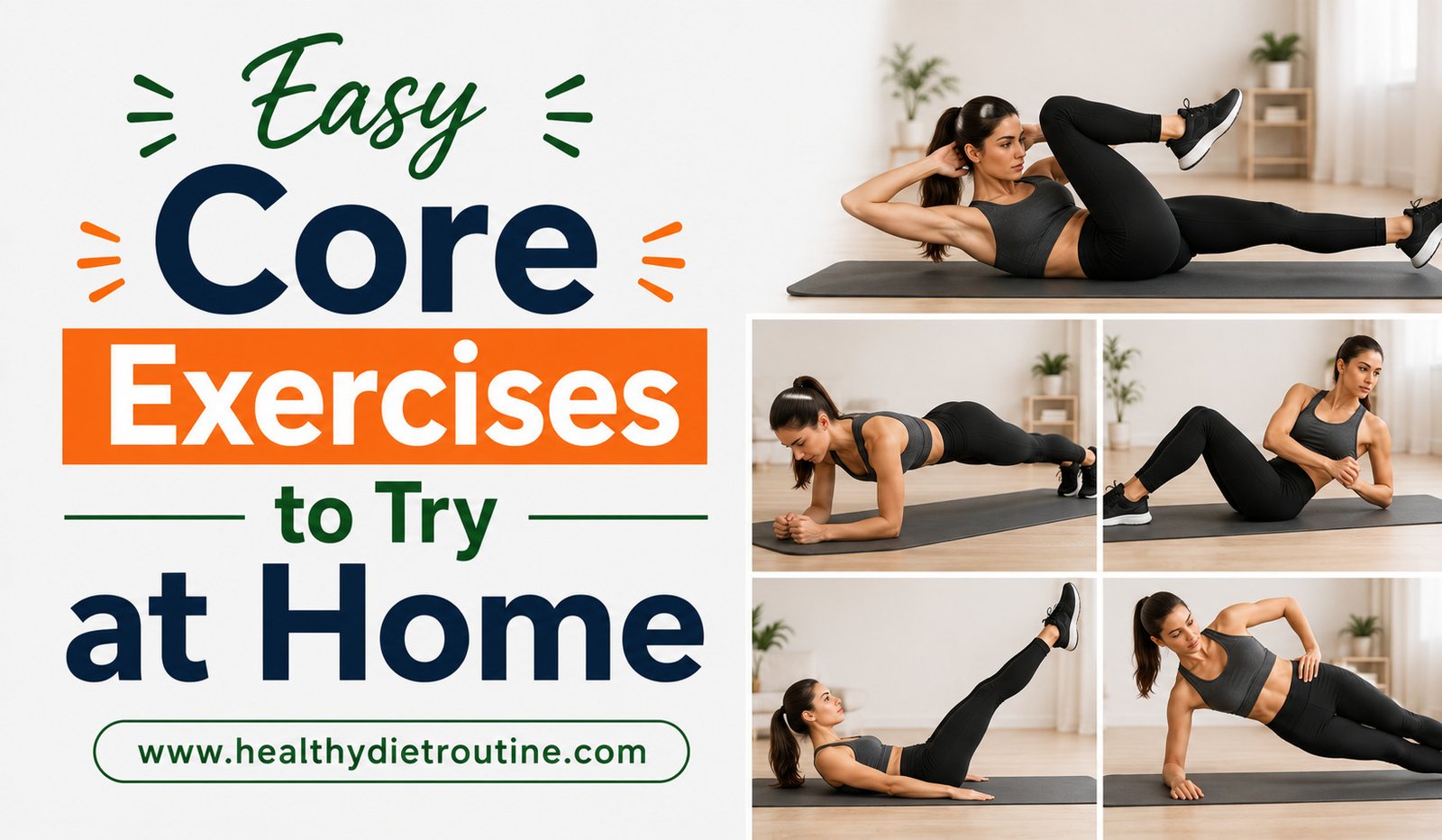
A strong core is useful for much more than getting visible abdominal muscles. The muscles around your abdomen, back, pelvis, and hips help stabilize your body during everyday activities such as walking, bending, lifting, climbing stairs, and exercising.
The good news is that you do not need a gym membership or expensive equipment to work on your core. Many beginner-friendly core exercises can be performed at home using only your body weight and a small amount of floor space.
If you are new to exercise, start with simple movements, focus on controlled technique, and increase the difficulty gradually. The following easy core exercises to try at home can help you build a basic routine.
Why Core Strength Matters
Your core helps transfer force between your upper and lower body and contributes to balance and stability. A well-conditioned core can make everyday movements feel more controlled and can support proper exercise technique.
Core training also involves more than traditional crunches. Exercises that challenge your ability to stabilize your spine, control your hips, and maintain balance can all contribute to core strength.
You do not need to perform hundreds of repetitions. Consistent, controlled practice is more useful than rushing through a large number of exercises.
1. Dead Bug
The dead bug is a beginner-friendly exercise that focuses on core control.
Lie on your back with your knees bent and lifted and your arms extended upward. Slowly lower one leg and the opposite arm toward the floor while keeping your torso stable. Return to the starting position and switch sides.
Move slowly and avoid arching your lower back excessively.
Start with 6–10 repetitions per side. If coordinating both limbs feels difficult, move one limb at a time.
2. Bird-Dog
Bird-dog works the core while also challenging balance and coordination.
Begin on your hands and knees with your hands beneath your shoulders and knees beneath your hips. Slowly extend one arm and the opposite leg. Hold the position briefly before returning to the starting position.
Switch sides and repeat.
Try 6–10 repetitions per side. The goal is stability, not how high you can lift your arm or leg.
3. Glute Bridge
Although glute bridges primarily involve the muscles around your hips and lower body, they also require core stability.
Lie on your back with your knees bent and feet flat on the floor. Keep your arms beside your body. Lift your hips slowly until your body forms a comfortable straight line from your shoulders toward your knees.
Pause briefly before lowering your hips.
Perform 10–15 repetitions with controlled movement.
4. Modified Plank
Planks are a popular core exercise, but beginners do not need to start with a long full plank.
Try a modified plank with your knees on the floor and your upper body supported on your forearms. Keep your torso steady and gently engage your abdominal muscles.
Hold the position for 10–20 seconds, rest, and repeat.
As you become stronger, you can gradually increase the holding time or progress to a full plank.
5. Side Plank From the Knees
Side planks can challenge the muscles on the sides of your core.
Lie on your side and support your upper body with your forearm. Bend your knees and keep them on the floor. Lift your hips gently while maintaining a comfortable alignment through your torso.
Hold for 10–15 seconds on each side.
If this variation becomes comfortable, you can gradually progress toward a full side plank.
6. Heel Taps
Heel taps are a simple movement that can be performed on the floor.
Lie on your back with your knees bent and feet flat on the floor. Lift your shoulders slightly if comfortable and reach one hand toward the corresponding heel. Return to the center and switch sides.
Keep the movement controlled instead of quickly moving from side to side.
Start with 8–12 repetitions per side.
7. Standing Knee-to-Elbow
Not every core exercise needs to be performed on the floor.
Stand upright with your feet comfortably apart. Lift one knee while bringing the opposite elbow toward it. Return to the starting position and alternate sides.
Perform the movement slowly at first. You can increase the pace once you are comfortable with the coordination.
Try 10 repetitions per side.
This exercise can be useful if you prefer standing workouts or have difficulty getting down onto the floor.
8. Marching While Bracing the Core
Core training can be surprisingly simple. Standing marches become more challenging when you focus on keeping your torso stable.
Stand upright and gently tighten your abdominal muscles without holding your breath. Slowly lift one knee, lower it, and then lift the other.
Avoid leaning from side to side.
Continue for 30–60 seconds, resting whenever needed.
9. Reverse Crunch
Reverse crunches can be introduced once basic core exercises become comfortable.
Lie on your back with your knees bent. Keep your legs lifted and gently bring your knees toward your chest, lifting your hips slightly from the floor. Lower yourself slowly.
The movement should be controlled rather than driven by momentum.
Beginners can start with 6–10 repetitions.
If you experience discomfort in your lower back, stop the movement and try an easier core exercise.
10. Bird-Dog Hold
If regular bird-dogs become easy, adding a brief hold can increase the stability challenge.
Extend one arm and the opposite leg and maintain the position for a few seconds. Keep your hips level and your torso stable.
Return to the starting position and switch sides.
Try 5–8 controlled repetitions per side, holding each position for a few seconds.
11. Seated Knee Lifts
Seated knee lifts are another option for beginners who prefer exercises that do not require lying on the floor.
Sit toward the edge of a sturdy chair with your feet on the floor. Keep your upper body upright and slowly lift one knee at a time.
Focus on maintaining good posture rather than leaning backward.
Perform 8–12 repetitions per side.
Use a stable chair and avoid chairs with wheels.
12. Slow Mountain Climbers
Traditional mountain climbers can be fast and demanding, but beginners can perform a slower version.
Start in a supported plank position with your hands on a stable elevated surface if necessary. Slowly bring one knee toward your chest and return it before switching sides.
Keep your upper body stable.
Perform the movement for 20–30 seconds and rest.
As your strength and coordination improve, you can gradually progress toward a floor-based variation.
A Simple Beginner Core Routine
You do not need to perform every exercise in one workout. A simple home routine could include:
- Dead bugs – 6–10 repetitions per side
- Bird-dogs – 6–10 repetitions per side
- Glute bridges – 10–15 repetitions
- Modified plank – 10–20 seconds
- Side plank from knees – 10–15 seconds per side
- Standing marches – 30–60 seconds
Start with one round and rest between movements. As the exercises become easier, you can add another round or gradually increase repetitions and holding time.
How Often Should You Train Your Core?
Your core does not necessarily need to be trained every day. Beginners can start with a few sessions per week and allow their bodies enough time to recover.
Core exercises can also be combined with walking, strength training, mobility work, or other forms of physical activity.
Remember that a stronger core comes from regular training over time rather than from doing an extremely intense workout once in a while.
Common Core Exercise Mistakes
One of the most common mistakes is moving too quickly. Fast repetitions can make it harder to maintain control and may encourage you to rely on momentum.
Another mistake is holding your breath. Try to breathe naturally throughout each movement.
You should also avoid assuming that more repetitions automatically mean better results. A smaller number of controlled repetitions can be more useful than a large number performed with poor technique.
Finally, do not focus only on abdominal exercises. A well-rounded fitness routine can include lower-body strength, upper-body movements, cardiovascular activity, flexibility, and balance work.
Tips for Exercising Safely at Home
Choose a clear, stable surface where you have enough room to move. A yoga or exercise mat can make floor exercises more comfortable, although it is not essential.
Start with easier variations and progress gradually. Mild muscle fatigue can be expected, but sharp or unusual pain should not be ignored.
If you have an existing injury, health condition, or specific exercise limitations, consider getting advice from an appropriate healthcare or fitness professional before starting a new exercise routine.
Final Thoughts
Easy core exercises at home can be a convenient way to improve stability, coordination, and strength without special equipment. Movements such as dead bugs, bird-dogs, glute bridges, modified planks, heel taps, and standing knee lifts are accessible starting points for beginners.
The key is to focus on controlled movement and consistency rather than trying to complete the hardest exercise immediately.
Start with a few exercises, practice them regularly, and gradually increase the challenge as your fitness improves. A simple routine performed consistently can be far more valuable than an overly complicated workout that is difficult to maintain.