
Easy Upper-Body Exercises Without Gym Equipment
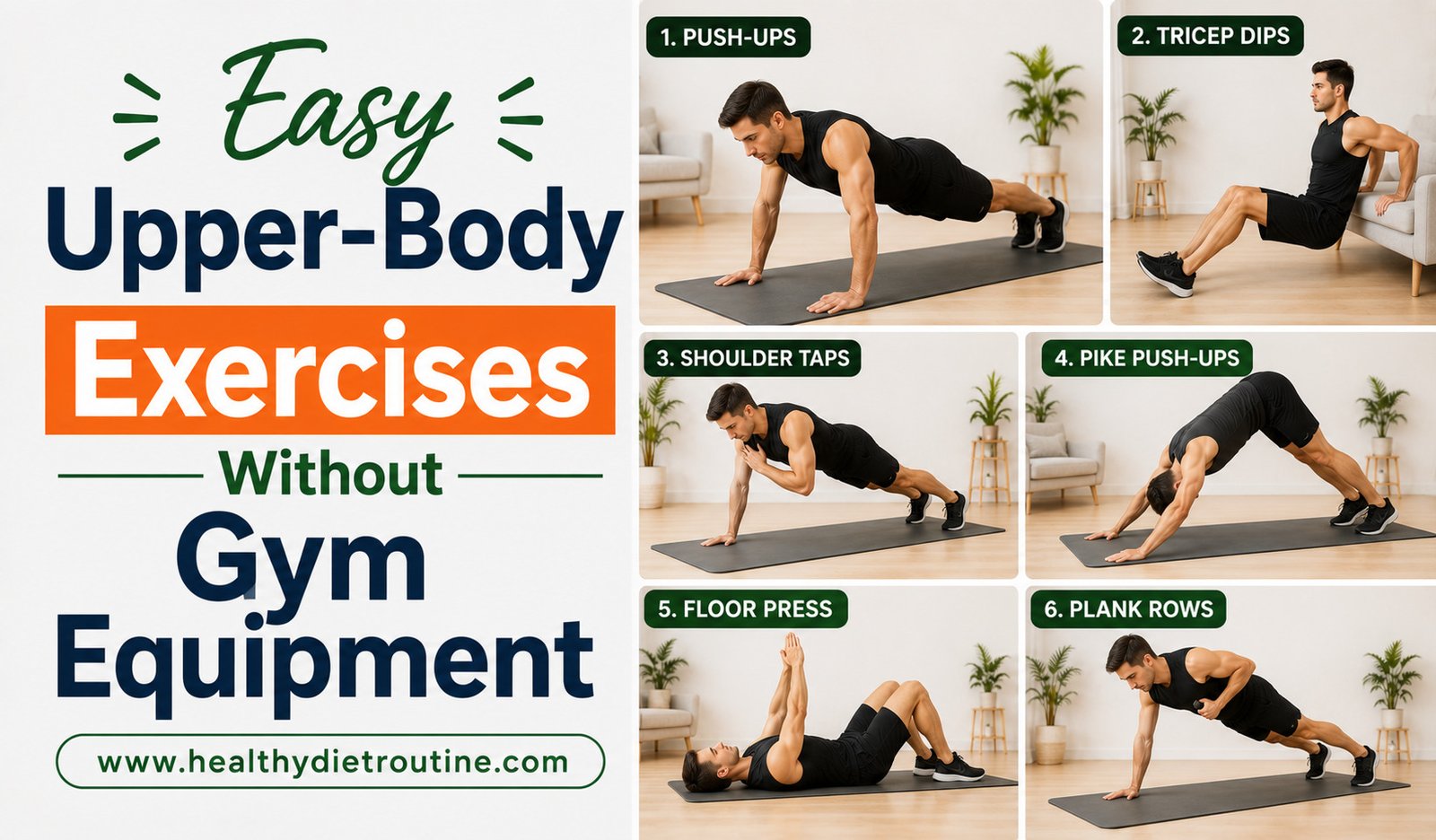
Building upper-body strength does not necessarily require a gym membership, dumbbells, or expensive workout machines. Many beginner-friendly exercises use your own body weight and can be performed at home with very little space.
Your upper body includes the muscles of the chest, shoulders, arms, upper back, and supporting core muscles. Strengthening these areas can make everyday activities such as carrying groceries, lifting objects, pushing doors, and maintaining good posture easier.
If you are just getting started, focus on controlled movements rather than trying to perform difficult exercises immediately. The following easy upper-body exercises without gym equipment can help you create a simple and practical home workout.
Why Upper-Body Strength Matters
Upper-body strength supports many everyday movements. Stronger arms and shoulders can help with lifting and carrying, while stronger chest and back muscles contribute to overall movement and stability.
You do not need to train at an advanced level to benefit from strength exercises. Beginners can start with easier variations and gradually progress as their muscles become accustomed to the movements.
Bodyweight exercises can also be adapted to different fitness levels. For example, wall push-ups are easier than floor push-ups, making them a useful starting point.
1. Wall Push-Ups
Wall push-ups are one of the simplest ways to introduce pushing movements into your routine.
Stand facing a wall and place your hands against it at about chest height. Keep your body relatively straight as you bend your elbows and bring your chest closer to the wall. Push through your hands to return to the starting position.
Start with 8–12 repetitions.
As you become stronger, you can progress to incline push-ups using a stable elevated surface.
2. Incline Push-Ups
Once wall push-ups feel comfortable, incline push-ups provide a greater challenge.
Place your hands on a sturdy table, countertop, or another secure elevated surface. Step your feet backward and keep your body aligned. Bend your elbows to lower your chest toward the surface, then push yourself back up.
Try 6–12 repetitions.
Make sure the surface is stable before beginning. Do not use lightweight furniture that could move or tip.
3. Knee Push-Ups
Knee push-ups can be a transition toward traditional floor push-ups.
Start on your hands and knees and place your hands slightly wider than shoulder width. Move your knees into a comfortable position and keep your upper body controlled as you lower and raise yourself.
Begin with 5–10 repetitions.
If maintaining good form is difficult, return to incline push-ups and build strength gradually.
4. Arm Circles
Arm circles are a simple movement that can warm up the shoulders and add light activity to an upper-body routine.
Stand upright and extend your arms comfortably to the sides. Make small circles with your arms, gradually increasing the size if it feels comfortable.
Perform the movement for 20–30 seconds, then reverse the direction.
Avoid forcing your shoulders through an uncomfortable range of motion.
5. Wall Shoulder Taps
Wall shoulder taps combine a supported position with controlled arm movement.
Stand facing a wall and place your hands against it. Keep your body stable while lifting one hand to tap the opposite shoulder. Return it to the wall and alternate sides.
Try 8–12 taps per side.
Focus on keeping your torso steady rather than moving quickly.
6. Standing Wall Press
A wall press is another accessible pushing exercise.
Stand facing a wall with your hands placed comfortably against it. Slowly bend your elbows and lean toward the wall, then push yourself back.
Unlike a standard wall push-up, you can experiment with a slightly narrower hand position to emphasize a different movement pattern.
Perform 8–12 controlled repetitions.
7. Plank Shoulder Taps
Plank shoulder taps can work the shoulders and arms while also requiring core stability.
Start in a high plank position with your hands beneath your shoulders. If a floor plank is too difficult, use a stable elevated surface.
Slowly lift one hand and tap the opposite shoulder. Return your hand and switch sides.
Try 5–10 taps per side.
Keep your hips as steady as possible and avoid rushing.
8. Triceps Dips With Caution
Triceps dips can be performed using a stable surface, but they require more control than some beginner exercises.
If you choose to try them, use a very sturdy, secure surface and keep the range of motion comfortable. Lower yourself slowly and avoid forcing your shoulders into a deep position.
For beginners, wall or incline pushing exercises may be more appropriate starting points.
If you experience shoulder discomfort, stop the exercise and choose another movement.
9. Superman
The Superman exercise works the muscles along the back of the body, including the back and shoulders.
Lie face down with your arms extended forward or slightly out to the sides. Gently lift your arms and legs a small amount from the floor while keeping the movement controlled. Lower them slowly.
Start with 6–10 repetitions.
You do not need to lift your limbs very high. Focus on comfortable movement and avoid excessive arching of your lower back.
10. Prone Y Raises
Prone Y raises are another bodyweight exercise that can involve the upper back and shoulders.
Lie face down and extend your arms forward at an angle to form a “Y” shape. Gently lift your arms a small amount and lower them again.
Perform 6–10 controlled repetitions.
Keep the movement small and comfortable, especially if you are new to upper-body training.
11. Standing Punches
Standing punches are an easy way to add movement to an upper-body workout.
Stand with your feet comfortably apart and your hands near your chest. Extend one arm forward in a controlled punching motion and return it. Alternate arms.
Continue for 30–60 seconds at a comfortable pace.
Avoid locking your elbows forcefully at the end of each punch.
You can use this exercise as a light movement break or as part of a warm-up.
12. Bear Plank Hold
A bear plank can challenge the shoulders, arms, and core.
Start on your hands and knees. Place your hands under your shoulders and your knees beneath your hips. If comfortable, lift your knees slightly from the floor while keeping your back relatively stable.
Hold for 10–20 seconds.
If this is too difficult, stay on your knees and focus on maintaining a strong hands-and-knees position.
A Simple Beginner Upper-Body Workout
You do not need to perform every exercise in one session. A beginner routine could include:
- Arm circles – 20–30 seconds
- Wall push-ups – 8–12 repetitions
- Incline push-ups – 6–10 repetitions
- Superman – 6–10 repetitions
- Wall shoulder taps – 8–12 per side
- Standing punches – 30–60 seconds
- Gentle shoulder stretches
Complete one round initially. As you become more comfortable, you can add a second round or gradually increase repetitions.
How to Progress Without Equipment
You can make bodyweight exercises more challenging without purchasing weights.
One simple method is to increase repetitions gradually. Another is to move from an easier variation to a harder one.
For example, you can progress from wall push-ups to incline push-ups, then knee push-ups, and eventually traditional push-ups if appropriate.
You can also slow down the lowering portion of exercises or add a short pause at the most challenging point.
The goal is gradual progression while maintaining good control.
Common Mistakes to Avoid
One of the biggest mistakes beginners make is trying to complete too many repetitions too quickly. Quality movement is more important than simply reaching a high number.
Another mistake is ignoring the muscles of the back. A balanced upper-body routine should not focus exclusively on pushing exercises. Movements such as Superman and prone Y raises can provide some work for the back and shoulders.
It is also important not to ignore discomfort. Muscle effort is normal, but sharp pain or unusual symptoms should not be pushed through.
Safety Tips for Home Workouts
Before exercising, clear the area around you and make sure any surface used for support is stable.
Start with gentle movements and gradually increase intensity. Maintain comfortable breathing throughout your workout and take breaks whenever necessary.
If you have an existing injury, medical condition, or specific exercise restrictions, consider consulting a qualified healthcare or fitness professional before beginning a new exercise program.
Final Thoughts
Easy upper-body exercises without gym equipment can provide a convenient starting point for improving strength at home. Wall push-ups, incline push-ups, arm circles, shoulder taps, Superman exercises, standing punches, and other bodyweight movements require little or no equipment.
You do not need to perform an advanced workout to make progress. Start with movements that match your current ability, practice them consistently, and gradually increase the challenge.
With patience and regular practice, simple home exercises can become the foundation of a stronger and more active lifestyle.